Biomedical engineers from Emory University have developed a smartphone app for the non-invasive detection of anemia. Instead of a blood test, the app uses photos of someone's fingernails taken on a smartphone to accurately measure how much hemoglobin is in their blood. The research was published today in Nature Communications.
"All other point-of-care anemia detection tools require external equipment, and represent trade-offs between invasiveness, cost, and accuracy," says principal investigator Wilbur Lam, M.D., Ph.D. "This is a standalone app whose accuracy is on par with currently available point-of-care tests without the need to draw blood."
The app is part of the PhD work of former biomedical engineering graduate student Rob Mannino, Ph.D., who was motivated to conduct the research by his own experience living with beta-thalassemia, an inherited blood disorder caused by a mutation in the beta-globin gene.
The researchers say that the app should be used for screening, not clinical diagnosis. It could facilitate self-management by patients with chronic anemia, allowing them to monitor their disease and to identify the times when they need to adjust their therapies or receive transfusions. The technology could also be used by anyone at any time, and could be especially appropriate for pregnant women, women with abnormal menstrual bleeding, or runners/athletes. Its simplicity means it could be useful in developing countries.
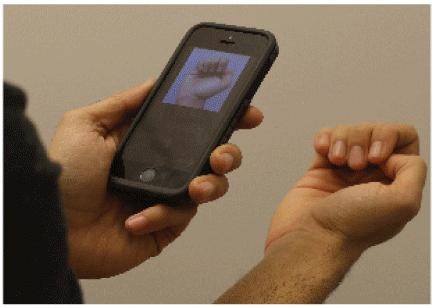 A single smartphone image, without personalized calibration, can measure hemoglobin level with an accuracy of 2.4 grams/deciliter with a sensitivity of up to 97%. Personalized calibration, tested on four patients over the course of several weeks, can improve the accuracy to 0.92 grams/deciliter, a degree of accuracy on par with point-of-care blood-based hemoglobin tests. Normal values are 13.5-17.5 grams/deciliter for males and 12.0-15.5 grams/deciliter for females.
In the app, the use of fingernail beds, which do not contain melanin, means the test can be valid for people with a variety of skin tones. The accuracy is consistent for dark or light skin tones, Mannino says. The app uses image metadata to correct for background brightness, and can be adapted to phones from multiple manufacturers.
Image: Fingernail beds are ideal for detection of anemia because they don't contain melanin. Image courtesy of Mannino et al Nature Communications 2018.