New research published today in Nature reveals that mycoplasma pathogens have a unique way of synthesizing DNA that protects them from our immune response, a finding that could provide new avenues to combat the pathogens that utilize this strategy.
Each time cells divide, they need to copy all the DNA in their genome, which requires the production of a large number of the four different DNA building blocks: adenine, guanine, thymine, and cytosine. The enzyme that makes these nucleotides is called ribonucleotide reductase (RNR).
Because of its essential role, RNR has been intensely studied for over 50 years. It has been observed that in all organisms—from bacteria to humans—RNR requires metal ions in order to function. Therefore, starving invading bacteria of metals is one general strategy that our immune system uses to fight infection.
However, the new study has found an exception to this observation. Vivek Srinivas, a graduate student at Stockholm University, says, "We discovered a family of RNR proteins in mycoplasma that does not need metals."
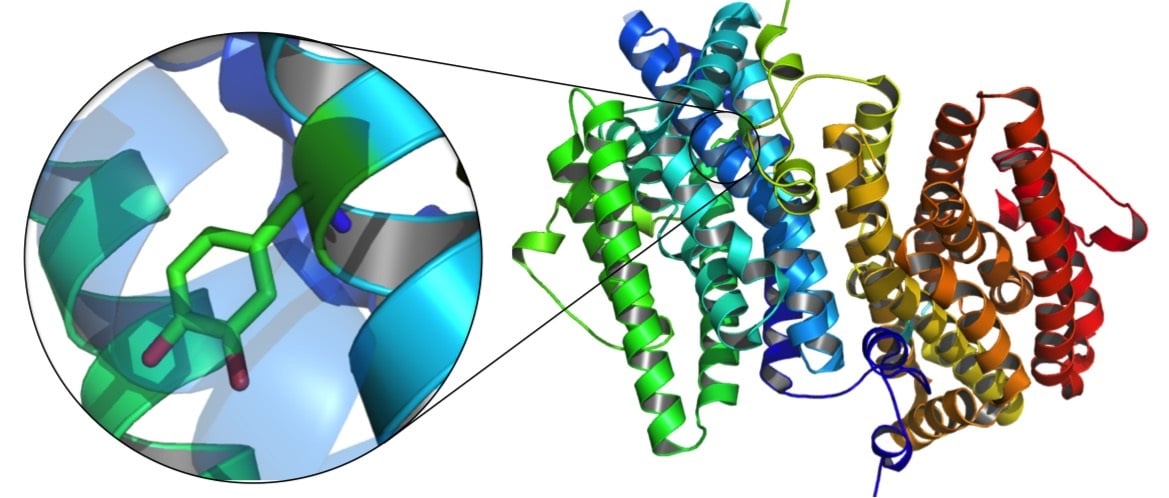
The study shows that instead of using metals, the RNR proteins in mycoplasma use a modified amino acid radical to initiate the chemical reaction. Radicals are molecules with an odd number of electrons, making them highly reactive.
Many of the bacteria that utilize this new group of RNR proteins are mycoplasma pathogens that invade mucosal surfaces in the respiratory and genital tracts. It is possible that this extraordinary method of synthesizing DNA nucleotides evolved so that the bacteria can survive and multiply despite a lack of metals.
"It is remarkable how evolution found an alternate chemical solution to this problem, something we didn't think was possible without metals,” says senior author Martin Högbom of Stockholm University. “Of course, this also means that there may be new avenues to combat the pathogens that utilize this strategy."
Image: A DOPA radical replaces the metal site in Mycoplasma RNR. Image courtesy of Hugo Lebrette.