Walter and Eliza Hall Institute researchers have discovered how the growth of milk-producing mammary glands is triggered during puberty. Sleeping stem cells in the mammary gland are awoken by a protein called FoxP1, according to the research that was published today in the journal Developmental Cell. The research expands our knowledge of how the mammary gland develops—a first step in understanding how defects in this process lead to breast cancer.
The research question required a team of scientists with diverse backgrounds. As co–research leader Jane Visvader put it, "This project brought together expertise in cell biology, developmental biology, bioinformatics, and imaging to solve the question of how mammary stem cells are awoken in puberty and adult breast tissue.”
Stem cells are the cells that give rise to a range of other cell types. They are often found in a dormant state in the body, and little is known about how they are awakened into an activated state. In breast tissue, mammary stem cells need to be woken up at puberty in order to drive the rapid expansion of the mammary gland.
"The mammary stem cells are ready for a signal to start dividing," Visvader says. "We discovered that a gene called FoxP1 is an essential part of this signal in puberty and the adult."
Nai Yang Fu, another co–research leader, adds that they “discovered that FoxP1 switches off the production of one of the key proteins that keep mammary stem cells asleep. As the level of this protein drops, the stem cells wake up and begin to divide, driving mammary gland growth."
According to the study, without FoxP1, mammary stem cells are locked in a dormant state forever and mammary glands cannot grow.
"We're still looking for the precise connections linking female hormones and FoxP1, but we are one step closer to understanding the detailed process of breast development,” Visvader says. “This is also helping us to connect faulty cells that contribute to breast development with the development of breast cancer."
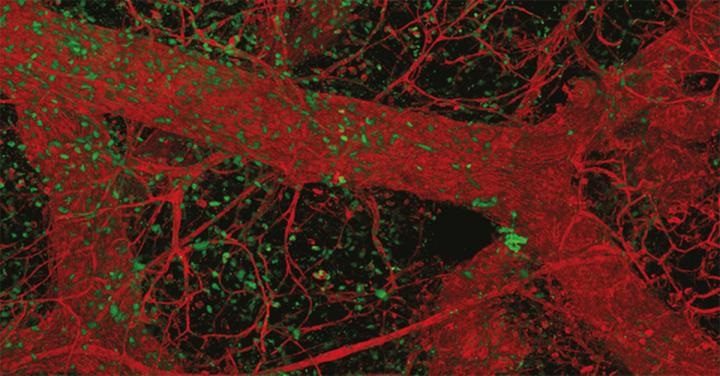
Image: High-resolution imaging of ducts in the mammary gland was critical for the discovery of how their growth is triggered in puberty. Image courtesy of Walter and Eliza Hall Institute, Australia.