Lungs are vital organs required for the uptake of oxygen in exchange for carbon dioxide. However, the enormous complexity of the respiratory organ is often underestimated and deserves a closer look: A broad range of specialized cells work closely together to ensure the proper functioning of the lung and to carry out the vital gas exchange. Among these cells are various immune cells, which keep invading microorganisms in check while at the same time preventing harmful inflammation.
The development and maturation of this complex organ during the embryonic stages and after birth was largely unknown. However, research published in Cell yesterday by scientists from Israel and Austria made an important contribution to the understanding of the pulmonary immune development using a combination of high-throughput single-cell RNA sequencing, functional assays, and cutting-edge microscopy methods.
Surprisingly, the researchers found that basophils, immune cells that are best known for their role in allergic reactions, reside in lungs, where they develop into a special subtype of cell that produces crucial growth factors and cytokines. These cells are different from the basophils that circulate in the blood, and their role in development and homeostasis, specifically in the lungs, was never reported before.
"We were able to show that the development of the lung proceeds in several waves and that lung resident basophils are important players," explains co-first author Anna-Dorothea Gorki of the Medical University of Vienna. "Basophils broadly interact with other cell types of the lung, especially macrophages. Molecular signals, emitted by basophils, assist in the maturation of macrophages into their lung-specific phenotype, the so-called alveolar macrophage."
Senior investigator Sylvia Knapp adds, "This discovery is very interesting, even from a medical point of view.” According to Knapp, their research could present a new potential target for immunotherapies.
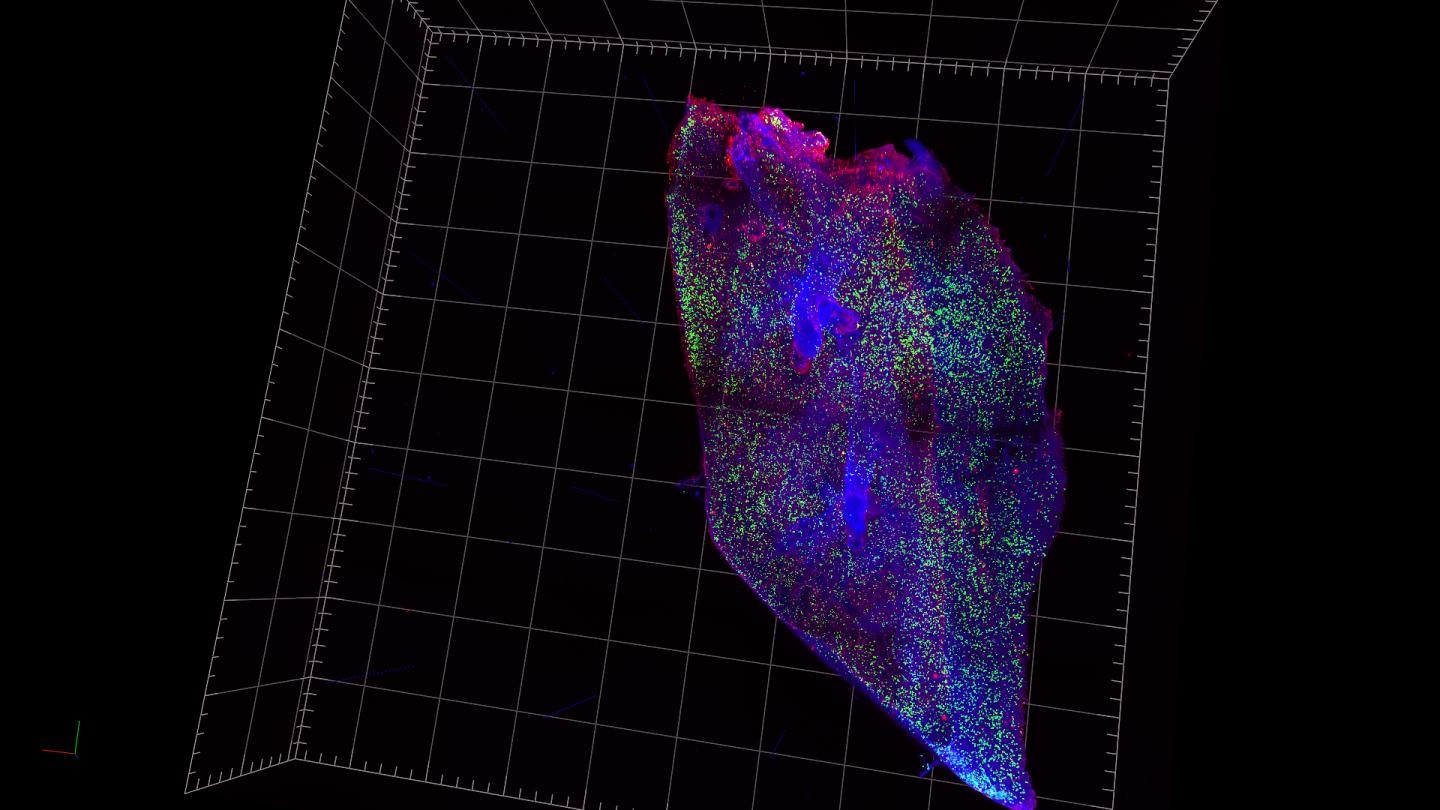
Image: This is a lightsheet image of mouse lung stained for different cell types and structures. Blue = bronchi, green = macrophages, red = basophils. Image courtesy of MedUni Wien/Anastasiya Hladik.