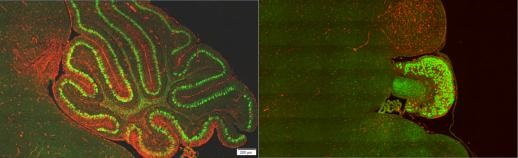
The metabolic needs of cells across the brain are not uniform, researchers have learned. "Knocking out" an enzyme that regulates mitochondria, the “power plants” of the cells, blocks the development of the mouse cerebellum more than the rest of the brain. The results are scheduled for publication in Science Advances.
"This finding will be tremendously helpful in understanding the molecular mechanisms underlying developmental disorders, degenerative diseases, and even cancer in the cerebellum," says lead author Dr. Cheng-Kui Qu of Emory University School of Medicine.
The cerebellum was long thought to be involved mainly in balance and complex motor functions, but recent research suggests that it is also important for decision-making and emotions. In humans, the cerebellum grows more than the rest of the brain in the first year of life, and its development is not complete until around eight years of age. The most common malignant brain tumor in children, medulloblastoma, arises in the cerebellum.
Qu and his colleagues have been studying the enzyme PTPMT1, which controls the influx of pyruvate—a source of energy derived from carbohydrates—into mitochondria. Deleting PTPMT1 provides insight into which cells are more sensitive to problems with mitochondrial metabolism. The researchers created multiple groups of mice that have the gene for PTPMT1 deleted in all neurons, in adult brains only, or in specific parts of the cerebellum only.
The team was surprised to find that pyruvate is critical for neural stem cells, even though they do not divide quickly, and that the defects in these cells were what caused complete block in cerebellar development in PTPMT1-deleted mice. In contrast, rapidly proliferating granule cells, a distinctively small type of cell found in the cerebellum, were not affected as much by the deletion.
Qu says that the distinction "represents a paradigm shift in our understanding of the metabolic regulation of various cell types in the developing cerebellum." According to Qu, it appears that neural stem cells rely more on efficient mitochondrial metabolism of glucose than progenitors and mature cells.
Image: Mouse cerebellum in control (left) and in PTPMT1 mutant (right). Green color represents calbindin, a neuronal marker expressed in the cerebellum. Image courtesy of Zheng et al. Science Advances (2018) via Creative Commons.