Polymers that are abundant at chronic infection sites cause bacteria to aggregate by the depletion aggregation mechanism, which results in marked antibiotic tolerance, according to research published yesterday in Proceedings of the Natural Academy of Sciences by University of Montana scientists.
"Antibiotic resistance is a major problem," said Patrick Secor, assistant professor in UM's division of biological sciences and lead researcher on the paper. "However, it is often the case that if you take bacteria that survive antibiotic treatment from someone's infected lungs and treat those same bacteria with antibiotics in the lab, the bacteria die. We wanted to understand why."
"We found that bacteria living in high concentrations of polymers get a little stressed out," said Lia Michaels, a researcher at UM and co-author of the paper. "Basically, the polymer-rich environment activates stress responses in the bacteria, causing them to tolerate higher levels of antibiotics."
The researchers also discovered that stress responses induced by mucus polymers pressing on the bacteria were a result of mild DNA damage in the bacterial cells.
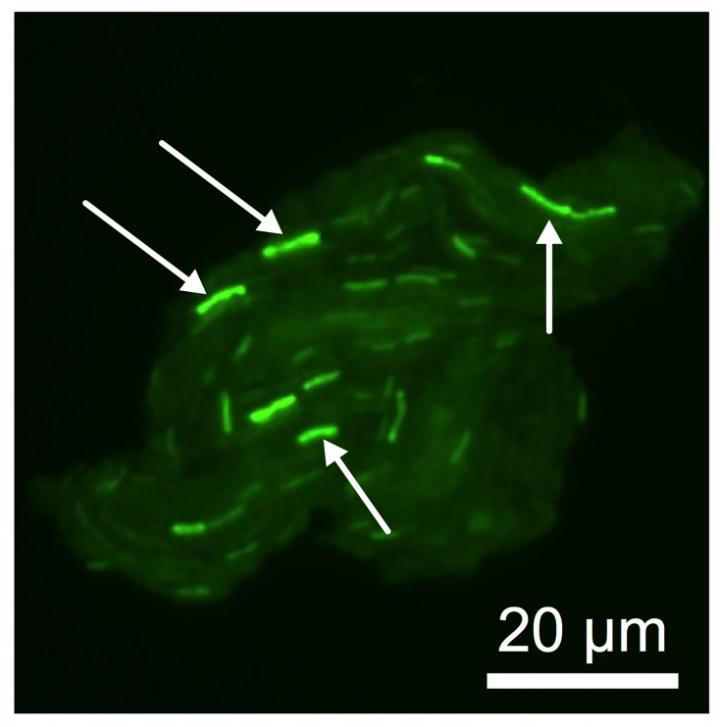
"One thing that this DNA damage did was slow bacterial growth," said Laura Jennings, UM research assistant professor and co-author of the paper. "Because most antibiotics work best on rapidly dividing cells, these slow-growing bacteria were more difficult to kill with antibiotics."
The researchers speculate that the mechanisms by which polymers turn on bacterial stress responses could be targeted therapeutically to treat long-term bacterial infections.
Image: Engineered bacteria fluorescing green in response to stress induced by growth in a polymer-rich environment. Image courtesy of Patrick Secor.