Just as a spacesuit protects astronauts from no-oxygen conditions, newly developed microbial “spacesuits” protect bacteria from oxygen toxicity. In a paper published today in the Proceedings of the National Academy of Sciences, scientists present a biohybrid system that combines live anaerobic bacteria with a metal–organic framework (MOF) that both protects the bacteria from oxygen and serves as a semiconductor to capture sunlight for use in carbon fixation.
"We are interfacing these bugs with a semiconductor that overwhelms them with electrons, so they can do more chemistry," says Peidong Yang of UC Berkeley. "But at the same time, this process also generates all these reactive oxygen species, which are detrimental to the bugs. We are putting these bacteria in a shell so that if any of these oxidative species comes in, this first defense, the shell, decomposes them."
While the present study focused on Morella thermoacetica, bacteria that produce acetate, MOFs can theoretically be used with other bacteria that produce other organic compounds. Industry scientists can take advantage of this to produce useful compounds in an environmentally friendly manner—converting carbon dioxide that is released from power plants into useful products using solar energy.
But the hybrid system could also be used to produce necessary compounds in otherwise inhospitable environments, such as in spaceships or on other planets.
"We are using our biohybrid to fix CO2 to make fuels, pharmaceuticals and chemicals, and also nitrogen fixation to make fertilizer," says Yang. "If Matt Damon wants to grow potatoes on Mars, he needs fertilizer."
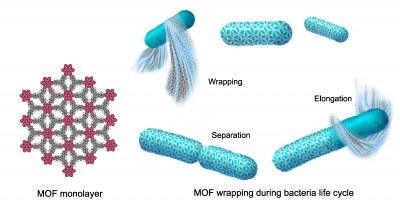
According to the researchers, the MOF layer is very thin (only 1–2 nm) and its bonding with the bacteria is dynamic. As such, cells can divide without losing any cytoprotective material. And as long as there is an excess of MOF in the culture media, new cells will likewise gain the protection of an MOF layer.
Yang and colleagues are now working to increase the efficiency of the biohybrid system’s light capture and electron transfer. "Once you fix or activate CO2—and that is the most difficult part—you can use many existing chemical and biological approaches to upgrade them to fuels, pharmaceuticals, and commodity chemicals," he says.
Image: A 2D MOF wraps around the bacteria to form a soft cloak that expands as the bacteria grow and split. The MOF protects them from oxygen, the reverse of a spacesuit, which protects astronauts from the airlessness of space. Image courtesy of the Peidong Yang lab, UC Berkeley.