On rare occasions, the amoeba Naegleria fowleri, which is commonly found in warm swimming pools, lakes, and rivers, can infect a healthy person and cause severe primary amebic meningoencephalitis (PAM), a "brain-eating" disease that is almost always fatal. According to the CDC, only four of 143 people known to be infected with N. fowleri in the U.S. from 1962 to 2017 have survived.
In a paper published in PLoS Pathogens today, researchers at Skaggs School of Pharmacy and Pharmaceutical Sciences at University of California San Diego report on the identification of three new molecular drug targets in N. fowleri and a number of drugs that are able to inhibit the amoeba's growth. Several of these drugs are already approved by the FDA for other uses, such as antifungal agents, the breast cancer drug tamoxifen, and antidepressant Prozac.
Senior author Larissa Podust, Ph.D., associate professor, and her team began by investigating N. fowleri's sterol biosynthesis pathway—a series of enzymes that build the amoeba's outer membrane. They inhibited three of these enzymes to see how it would affect the organism's viability. The researchers found that all three enzymes might make good drug targets. One of these, a sterol isomerase, is similar to a human receptor known to play a role in human neurological conditions, such as addiction, amnesia, pain, and depression.
The researchers then tested a number of drugs already known to inhibit these enzymes for their ability to inhibit N. fowleri growth in the lab. All 13 of the new drugs they tested were more potent than miltefosine, an investigational drug currently recommended by the CDC for the treatment of PAM, in combination with other medications.
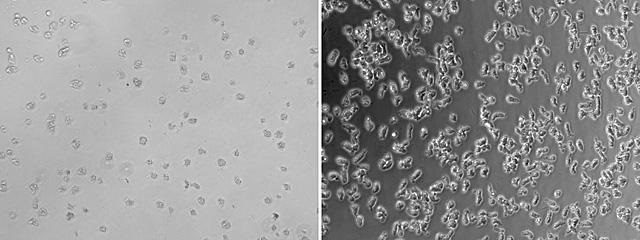
For example, while it takes 54.5 micromolar of miltefosine to arrest the growth of half the amoebae growing in a dish, it only took 5.8 μM of tamoxifen and 31.8 μM of Prozac. Tamoxifen and Prozac inhibit two different enzymes in N. fowleri's sterol biosynthesis pathway. When the researchers combined a lower dose of tamoxifen with drugs that inhibit other enzymes in the sterol biosynthesis pathway, they were able to inhibit the growth of 95% of N. fowleri.
"Drug repurposing is a relevant strategy for this infection because there is little economic incentive for the pharmaceutical industry to develop new drugs to treat these rare diseases," co-first author Anjan Debnath, Ph.D., assistant professor, explained. "Already-approved drugs can also lessen the time and expense required to develop a drug from the laboratory to the clinic."
Image: N. fowleri growth is inhibited with a combination treatment of breast cancer drug tamoxifen and epiminolanosterol (left) as compared to the untreated amoebae (right). Image courtesy of UC San Diego Health.