Mycobacterium tuberculosis (Mtb) causes infection by replicating inside macrophages. In an effort to further understand the dynamics between Mtb and its cellular host, a new study uses mass spectrometry to identify the interactions between tuberculosis proteins and human proteins. The published work in Molecular Cell comes from a collaboration that includes Gladstone Institutes, UC San Francisco, and UC Berkeley.
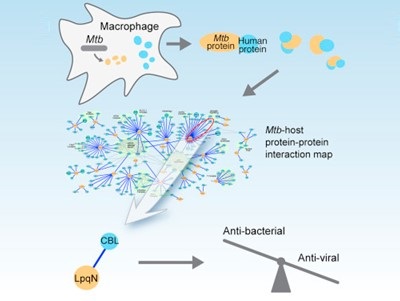 "It's the first time this approach has been applied to tuberculosis," said study senior co-author Jeffery Cox. "Essentially, this technology works by placing a hook on the tuberculosis proteins. When we fish them out of the human cells, the human proteins to which they're attached come with them, so we can see what they interact with."
During infection, Mtb produces approximately 100 genes, whose functions in the host remain relatively unknown. Using affinity tag purification mass spectrometry (AP-MS), the team was able to target 34 secreted Mtb proteins and identify their interacting partners within the human host cell.
"We found 187 interactions between these tuberculosis proteins and human proteins," said senior co-author Nevan Krogan from UCSF. "Each one of those connections could ultimately represent a drug target—a new way to fight tuberculosis."
One notable interaction was of the human CBL protein and the Mtb protein, lpqN. Mtb bacteria with a mutated lpqN gene become harmless. Interestingly, when the CBL protein is also removed, the tuberculosis infection is restored. On the other hand, when CBL gene is completely silenced within macrophages, the cells become resistant to viral infection. This suggests that CBL must function in regulating antibacterial and antiviral immunity.
The team concluded that the mapping of protein-protein interactions is useful in developing a deeper understanding of the intricate interactions between Mtb and its host.
"Most therapies to fight infection currently target the virus or bacteria," said Krogan. "But viruses and bacteria mutate quickly and develop resistance to existing treatments. Instead, we want to target human host proteins involved in common pathways. This could allow us to develop therapies that use a single drug to treat multiple pathogens."