A team of researchers from the University of Illinois has devised a nanotechnology-based method for detecting and treating the harmful bacteria that cause plaque and lead to tooth decay and other detrimental conditions. Their methodology, which relies on hafnium oxide nanoparticles, is described in a recent Biomaterials paper.
"Presently in the clinic, detection of dental plaque is highly subjective and only depends on the dentist's visual evaluation," said bioengineering associate professor Dipanjan Pan, head of the research team. "We have demonstrated for the first time that early detection of dental plaque in the clinic is possible using the regular intraoral X-ray machine, which can seek out harmful bacteria populations."
In order to accomplish this, Fatemeh Ostadhossein, a bioengineering graduate student in Pan's group, developed a plaque detection probe that works in conjunction with common X-ray technology and which is capable of finding Streptococcus mutans in a complex biofilm network. Additionally, they demonstrated that by tweaking the chemical composition of the probe, it can be used to target and destroy the S. mutans bacteria.
The probe is comprised of nanoparticles made of hafnium oxide (HfO2), a non-toxic metal that is currently in clinical trials. In their study, the team demonstrated the efficacy of the probe to identify biochemical markers present at the surface of the bacterial biofilm and simultaneously destroy S. mutans.
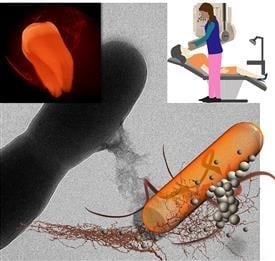
In practice, Pan envisions a dentist applying the probe on the patient's teeth and using the X-ray machine to accurately visualize the extent of the biofilm plaque. If the plaque is deemed severe, then the dentist would follow up with the administering of the therapeutic HfO2 nanoparticles in the form of a dental paste.
Image: Nanoparticles attach to or are taken up by the bacteria cells. Pan and his students were able to demonstrate that early detection of dental plaque in the clinic is possible using the regular intraoral X-ray machine, which can seek out harmful bacteria populations. Image courtesy of University of Illinois Laboratory for Materials in Medicine.