A novel method published in Nature Nanotechnology highlights the possibility of streamlining the analysis of proteins from a single blood sample. The work, which comes from a research team from McGill University, offers the potential of a rapid, high throughput and cost-effective tool for diagnostics and biomedical research.
 "Current technologies hold a major trade-off between the number of proteins that can be measured at once, and the cost and accuracy of a test,” said study first author Milad Dagher. "This means that large-scale studies, such as clinical trials, are underpowered because they tend to fall back on tried-and-true platforms with limited capabilities."
The team’s method aims to improve on the limitations of multicolor Förster resonance energy transfer (mFRET). They noted that mFRET, which uses fluorescently barcoded microparticles, results in a complex, non-orthogonal fluorescence response that impedes data encoding and decoding.
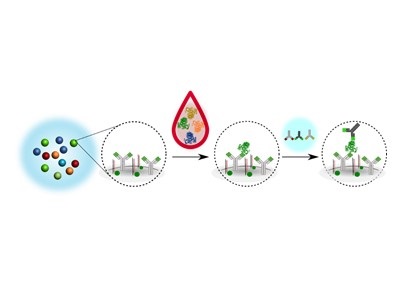
The new system, called ensemble mFRET (emFRET), introduces a multicolor labeling method that uses oligonucleotides as homogenous linkers. Over 500 differently-colored microbeads were generated that—through barcoding—can then be detected in parallel with high accuracy from the same solution.
“A total of 580 barcodes were rapidly designed and validated using four dyes—with FRET efficiencies reaching 76%—and used for multiplexed immunoassays with cytometric readout and fully automated decoding,” the team concluded.
“The emFRET model helps to expand the barcoding capacity of barcoded microparticles using common organic dyes and will benefit other applications subject to stochastic mFRET.”
The team hopes to use this platform for improved analysis of proteins. Among their goals is to increase the scale while maintaining accurate detection.
Image: The method combines multicolor FRET, barcoding, and multiplex immunoassays for high throughput protein analysis from the blood. Image courtesy of McGill University.