Using genetic barcodes enabled by homing guide RNA (hgRNA), scientists at the Wyss Institute and Harvard Medical School (HMS) have developed a method to actively record cell division in developing mice, enabling the lineage of every cell in a mouse's body to be traced back to its single-celled origin. Their research was published yesterday in Science.
"Current lineage-tracking methods can only show snapshots in time, because you have to physically stop the development process to see how the cells look at each stage, almost like looking at individual frames of a motion picture," said senior author George Church, Ph.D., professor of health sciences and technology at Harvard and MIT. "This barcode recording method allows us to reconstruct the complete history of every mature cell's development, which is like playing the full motion picture backwards in real-time."
The genetic barcodes are created using homing guide RNA. hgRNA molecules are engineered such that when the enzyme Cas9 is present, the hgRNA will guide the Cas9 to its own hgRNA sequence in the genome, which Cas9 then cuts. When the cell repairs that cut, it can introduce genetic mutations in the hgRNA sequence, which accumulate over time to create a unique barcode.
The researchers implemented the hgRNA-Cas9 system in mice by creating a "founder mouse" that had 60 different hgRNA sequences scattered throughout its genome. They then crossed the founder mouse with mice that expressed the Cas9 protein, producing zygotes whose hgRNA sequences started being cut and mutated shortly after fertilization.
"In every single cell that the zygote divides to become, there's a chance that its hgRNAs will mutate," explained first author Reza Kalhor, Ph.D., a postdoctoral research fellow. "In each generation, all the cells acquire their own unique mutations in addition to the ones they inherit from their mother cell, so we can trace how closely related different cells are by comparing which mutations they have."
Each hgRNA can produce hundreds of mutant alleles; collectively, they can generate a unique barcode that contains the full developmental lineage of each of the ~10 billion cells in an adult mouse.
The ability to continuously record cells' development also allowed the researchers to resolve a longstanding question regarding the embryonic brain: does it distinguish its front from its back end first, or its left from its right side first? By comparing the hgRNA mutation barcodes present in cells taken from different parts of two mice's brains, they found that neurons from the left side of each brain region are more closely related to neurons from the right side of the same region than to neurons from the left side of neighboring regions. This result suggested that front-back brain patterning emerges before left-right patterning in the development of the central nervous system.
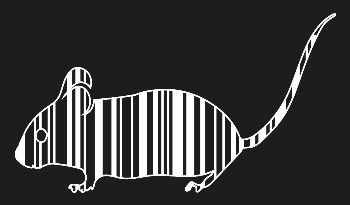
Image: The genetic barcodes are created using a special type of DNA sequence that encodes a modified RNA molecule called a homing guide RNA. image courtesy of Wyss Institute at Harvard University.