Recently published research describes how epithelial cells, which cover the surfaces of many organs, adopt a previously undescribed geometric shape, the scutoid, so that tissue can curve. A scutoid is defined as a solid geometric shape, like a cube or a pyramid. This novel shape, which was described in a paper published today in Nature Communications, allows organs to acquire complex yet stable forms.
"The epithelial cells are the "construction blocks" with which an organism is formed... During the development of an embryo, it changes from a simple structure formed from only a handful of cells to an animal with very complex organs. This process doesn't only occur because of the growth of the organism, but also because the epithelial cells start moving and joining together to organize themselves correctly and give the organs their final shape," explains University of Seville Biology faculty teacher Luisma Escudero.
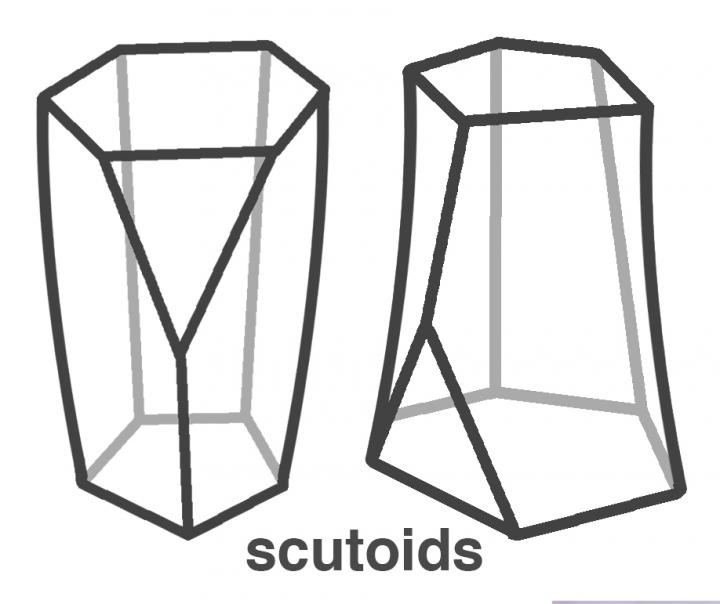
Until now, these "blocks" were represented as being prism-shaped or being like truncated pyramids. However, upon examining epithelial curves in laboratory samples, the researchers found evidence that these cells adopt other more complex shapes. "This is due to the fact that when tissue curves it tends to minimize energy, to be more stable, and for that reason our biophysical data indicates that what these cells do is adopt an scutoid shape," adds Escudero.
According to the team, this study opens the door to understanding how organs are formed and what might be missing in some diseases in which this process is altered. They hope to apply this knowledge to the creation of artificial tissue and organs.
Image: A scutoid is defined as a solid geometric shape, like a cube or a pyramid. Image courtesy of University of Seville.