Phosphatases are thought to be a desirable target for drug discovery, but the obstacles to working with this enzyme family have led some to label them as “undruggable”. A new system developed by scientists from the Medical Research Council (MRC) Laboratory of Molecular Biology, in Cambridge, UK brings scientists closer to being able to specifically target members of the phosphatase family. According to their paper, recently published in Cell, the system was used to identify a molecule that could successfully target a phosphatase to reduce accumulation of a Huntington’s disease-associated proteins in mouse brains.
Phosphatase and kinase enzymes are both involved in cell signaling, with kinases being activators of signaling and phosphatases turning it off. While drugs have been developed to target kinases, drugs that can specifically target phosphatases has been difficult due to the fact that the functional part is common to all phosphatases—drugging one phosphatase can lead to all of them being inhibited.
The new system builds on previous work by the team in which functional synthetic versions of phosphatase proteins were built. These phosphatases are tethered to chips so they can find a molecule that binds one type of phosphatase, but none of the others.
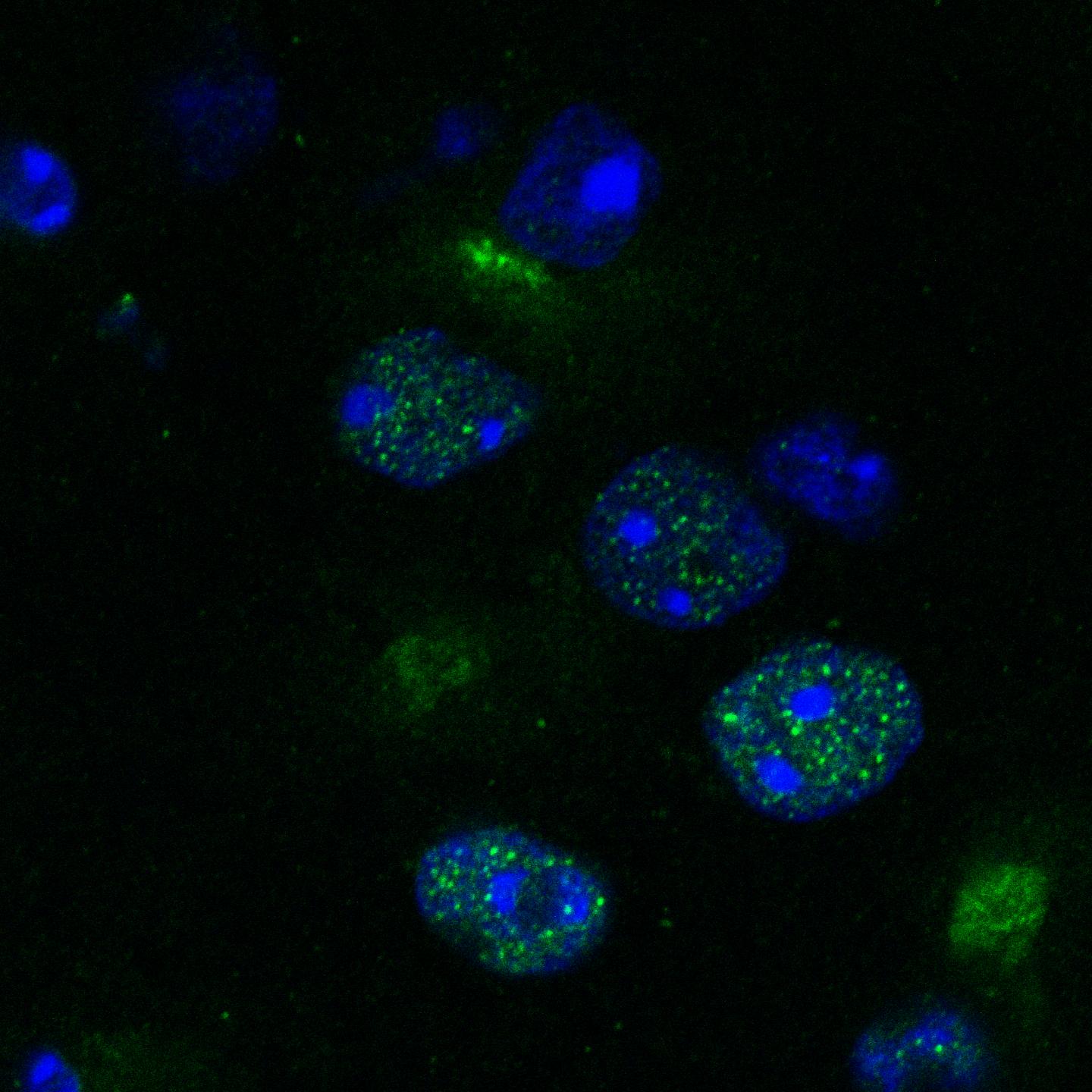
The system was used to find a way to target a specific phosphatase (designated 'PPP1R15B') that is involved in Huntington’s disease. They identified a molecule called Raphin1 that only targeted this phosphatase. They tested Raphin1 in a mouse model of Huntington’s disease and found it could cross into the brain where it reduced accumulation of misfolded proteins in neurons.
The researchers stress that these results are highly preliminary and more research is needed before validating these targets for human clinical trials.
Image: This is a Huntingtin protein (green) accumulated in the cells from the brains of mice given a placebo. Image courtesy of Krzyzosiak et al./ Cell.