Current approaches to treating traumatic brain injury (TBI) focus on preventing neurons from degenerating or promoting their survival. However, TBI often also affects the connections of neural circuits within injured brain regions, affecting the person’s memory. In a recent study, a Rutger’s University-led team has identified two small molecule compounds that may protect neurons post-injury and improve the outcome of TBI.
 "The big issue with treatment after TBI is that there are no drugs that work well on patients to restore memory, and we're targeting reconnectivity of neural circuitry. That means we want our neurons to function properly and connect with other neurons. We want to allow people to retain their cognition and ability to remember and learn, so our angle is novel," said Bonnie L. Firestein, senior co-author of the study published in Neurobiology of Disease.
The team focused on targeting the enzyme, cytosolic PSD-95 interactor (cypin). As the primary guanine deaminase in the brain, cypin is central to signaling processes that lead to synaptic development, dendrite branching, and neuronal plasticity.
To identify pharmacological tools for manipulating cypin in vivo, the team used a small molecule screen. A primary screen identified compounds that changed the rate of guanine deamination using a colorimetric assay, and a secondary screen measured the ability of compounds to protect neurons from injury. As a result, the team was able to identify two activators and one inhibitor.
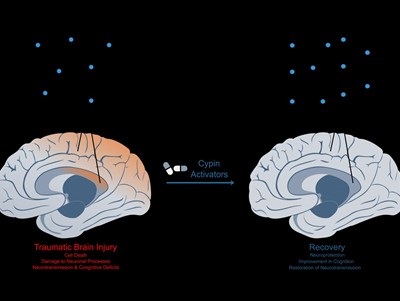
“Administering either cypin activator directly into the brain one hour after traumatic brain injury significantly reduced fear conditioning deficits 5 days after injury, while delivering the cypin inhibitor did not improve outcome after TBI,” the team reported.
While the inhibition of cypin appears to have little effect, using activators seems to be a promising avenue for treatment following TBI.
The team concludes: “Together, these data demonstrate that cypin activation is a novel approach for improving outcome after TBI and may provide a new pathway for reducing the deficits associated with TBI in patients.”
Image: Traumatic brain injury causes widespread damage to neurons, leading to deficits in learning and memory. Cypin activators restore neuronal survival and function in mice, allowing for normal learning and memory. Image courtesy of Mihir Patel/Rutgers University-New Brunswick.