Researchers from Stowers Institute for Medical Research have developed a new cell-based fluorescence assay called Distributed Amphifluoric FRET (DAmFRET) to quantify nucleation in living cells. According to the team, this new assay can distinguish between proteins that exhibit prion behavior and those that do not. This approach may help researchers understand more about prions associated with diseases as well as prions involved in normal biological processes. Results from their study were published today in Molecular Cell.
In their quest to understand what exactly makes a protein a prion, Stowers assistant investigator Randal Halfmann, and his lab members used DAmFRET to determine some of the key biophysical properties of nucleation for proteins expressed in baker's yeast cells. They determined that the key property of prion-forming proteins that distinguishes them from other proteins is their ability to become super-saturated. "Unlike other proteins that began to aggregate as soon as they were sufficiently concentrated inside cells, prion forming proteins instead remained soluble, and only aggregated when very rare random fluctuations in a few molecules provided a template to do so," Halfmann said.
Previous investigations of prions have been hindered by a lack of quantitative assays. Using DAmFRET, the Halfmann lab reported it was the first research group to successfully measure the frequency of nucleation as a function of protein concentration inside cells. They are now using the approach to investigate how nucleation happens for prion-like proteins responsible for Alzheimer's and other brain diseases.
Halfmann and his lab have been sharing the approach with scientists at other academic research centers. "Most labs do not have the equipment and throughput to use DAmFRET at our scale and resolution. So we are happy to collaborate with outside scientists by testing the proteins that they are investigating," Halfmann added.
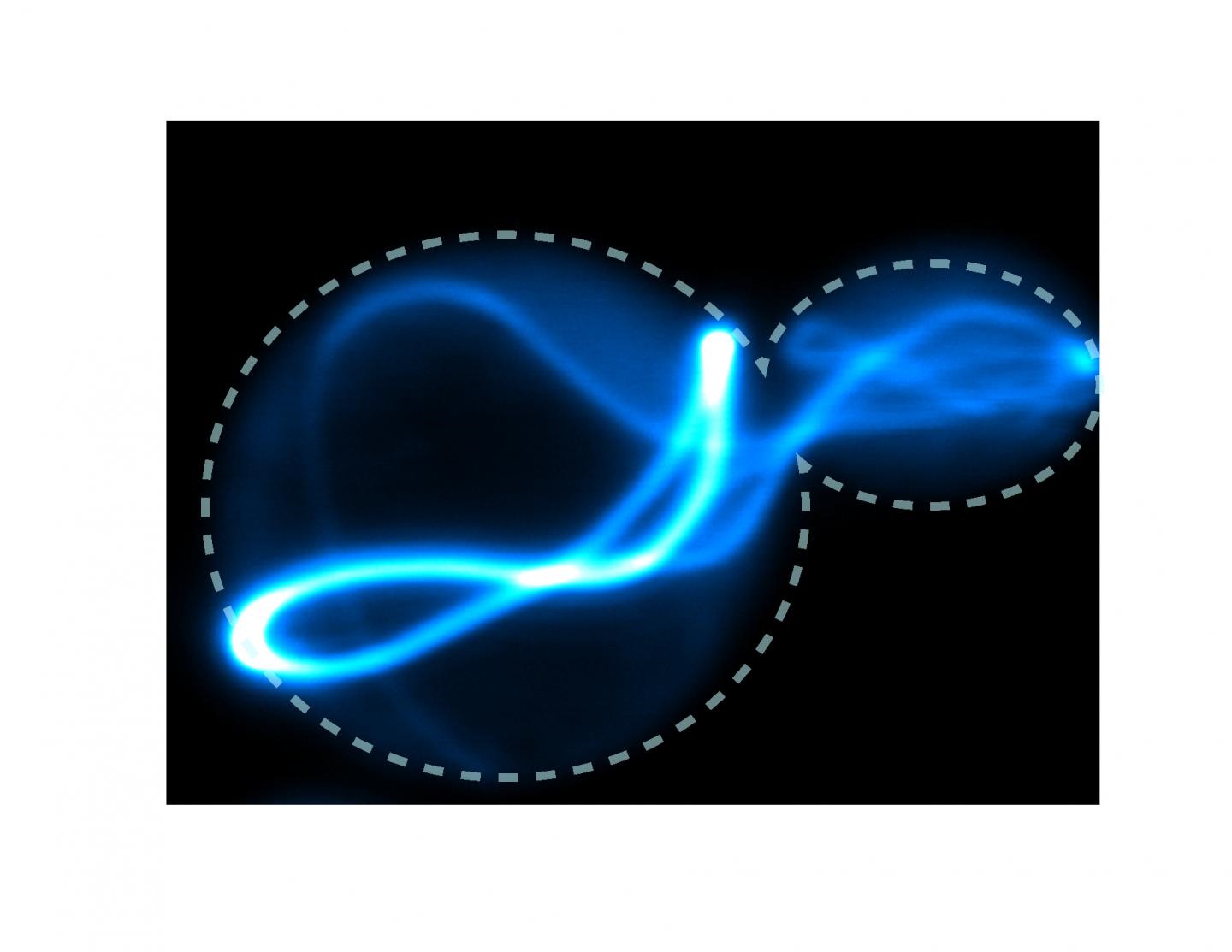
Image: Prion polymers of the functional human prion protein, ASC, expressed in baker's yeast cells. Prion phenomena occur because of the improbability of proteins acquiring ordered structure spontaneously. Image courtesy of Halfmann Lab.