The product of a natural enzyme may become key in the development of new antiviral drugs broadly targeting viruses such as West Nile, Zika, hepatitis C, and HIV. A recent publication in Nature highlights the mammalian enzyme viperin and its novel product, a fake nucleotide that disrupts viral replication. The work comes from a team led by researchers at Penn State and Albert Einstein University.
 “Viperin catalyzes an important reaction that results in the creation of a molecule called ddhCTP,” said study senior co-author Craig Cameron. “Surprisingly, the molecule acts in a similar manner to drugs that were developed to treat viruses like HIV and hepatitis C.”
In their paper, the team demonstrated that viperin catalyzed the conversion of the RNA precursor cytidine triphosphate (CTP) into 3ʹ-deoxy-3′,4ʹ-didehydro-CTP (ddhCTP), a previously undescribed nucleotide analog. Production of substantial amounts of ddhCTP was observed in mammalian cells expressing viperin and stimulated macrophages.
As it turns out, ddhCTP can incorporate into the viral genome to disrupt the activity of viral RNA polymerases, inhibiting RNA replication. The team notes: “We also establish that ddhCTP acts as a chain terminator for the RNA-dependent RNA polymerases from multiple members of the Flavivirus genus, and show that ddhCTP directly inhibits replication of Zika virus in vivo.”
"The molecule directly inhibited replication of three different strains of Zika virus. It was equally effective against the original strain from 1947 as it was against two strains from the recent 2016 outbreak,” said study co-author Joyce Jose. "This study highlights a new avenue of research into natural compounds like ddhCTP that could be used in future treatments."
While previously tested antiviral nucleotide analogs have exhibited effects on unintended targets, ddhCTP did not appear to show off-target effects. The team attributes the lack of toxicity of the compound to its natural origin within the body.
“With a better understanding of how viperin prevents viruses from replicating, we hope to be able to design better antivirals," said Cameron.
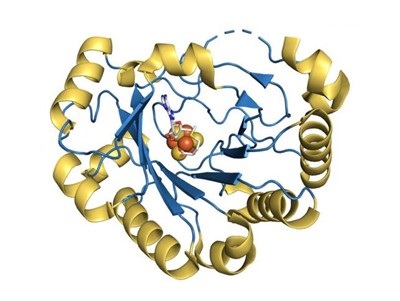
Image: A structural model of viperin, a naturally occurring enzyme in humans. Image courtesy of David W. Gohara.