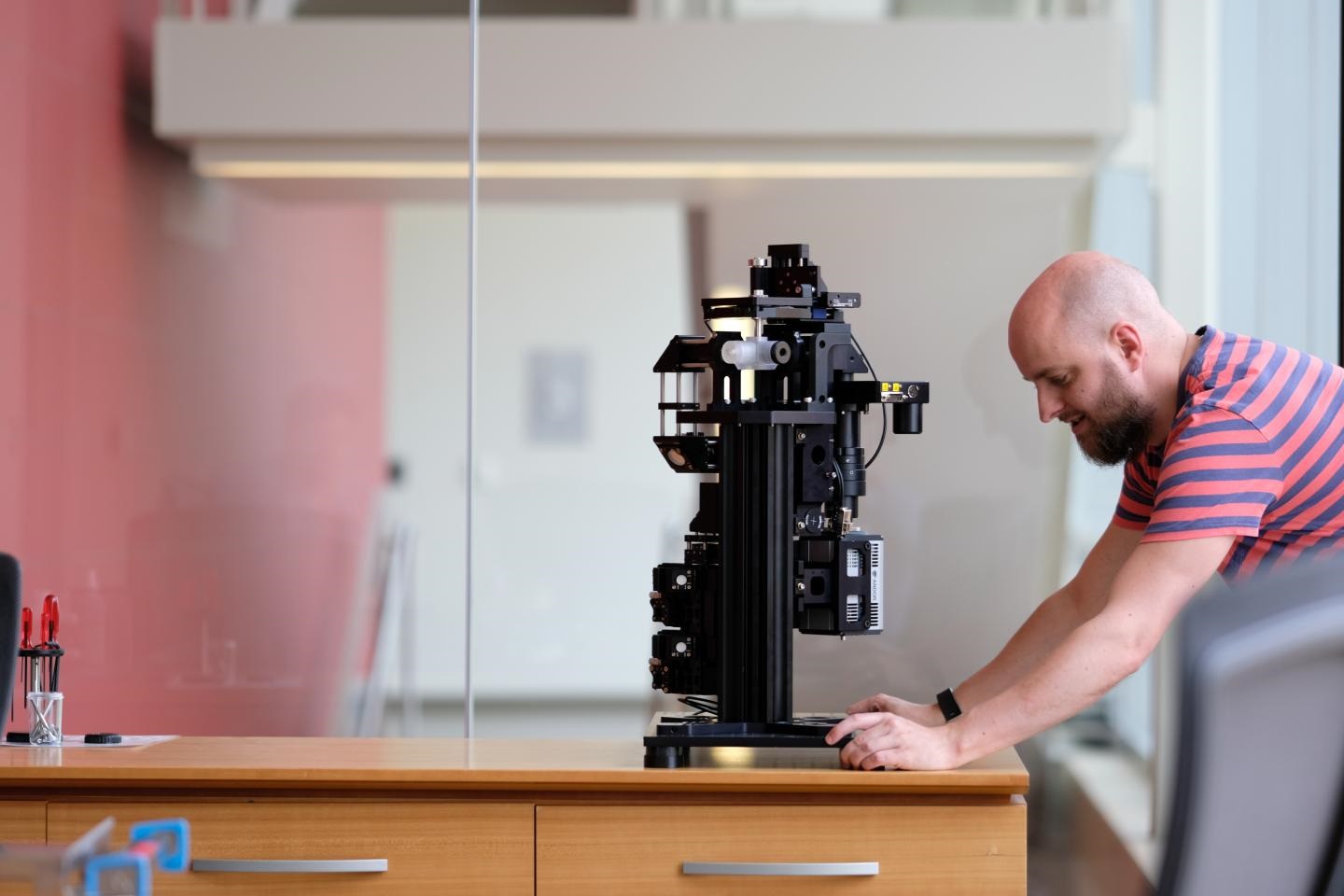
A portable, shareable light sheet microscope has been developed by the technology’s co-founder Jan Huisken and his team at Morgridge Institute for Research. Their new suitcase-sized version is intended to help make the technology more accessible.
Light sheet microscopes illuminate samples from the sides with non-invasive "sheets" of light, giving scientists the ability to image samples over hours and days from every angle. This helps generate a tremendous amount of data quickly and gives researchers a 3D view of development in an almost completely unaltered state. The technology is of great interest to the zebrafish research community according to the Morgridge team.
The team shrunk the typically tabletop-sized technology down to the weight and dimensions of a suitcase such that it can be mailed to a lab anywhere in the world, configured remotely by Morgridge engineers, and run one to three months of experiments. The microscope then either begins its mail-order journey to the next lab, or back to the Morgridge lab if a tune-up is needed—all at no cost to users.
The team presented the technology—nicknamed "Flamingo" for its one-legged stand and vertical profile—yesterday at the International Zebrafish Conference.
"If we succeed, this project will certainly have a huge impact in the field of fluorescence microscopy and significantly change the way we collaborate," says Huisken.
Labs fortunate enough to afford a commercial microscope can keep their entire experiments in-house. But as biologists, not engineers, customizing from one project to the next is difficult and the expensive tool may drift into obsolescence, says Huisken. The budget-challenged may need to take their project to the nearest shared microscopy resource. But biology doesn't travel well: Delicate samples may get altered or ruined along the way, and experiments may fail in the unfamiliar environment, he says.
Susi Power, a Huisken lab member on the Flamingo development team, says the lab has been seeing for years the challenges biologists face in getting access to good imaging. One of the added benefits of this project will reflect back to the Huisken lab as a kind of research crowd-sourcing. In exchange for using the technology, the lab helps expand the light-sheet user community and gets continual feedback on how to improve its core technology.
Image: Morgridge Institute Postdoctoral Fellow Rory Power inspects the completed 'Flamingo' light sheet microscope, which at a little over 40 pounds can be mailed to biology labs around the globe. Image courtesy of Jan Huisken.