A new type of cell state has been uncovered by scientists from American University. The team believes that this stem-like multipotent cell fate may be involved in regulation of adipose expandability and thus play a key role in obesity. Details on their research were published earlier this week in the American Journal of Stem Cells.
While growing stem cells in the petri dish, the team noticed some stem cells not following orders. As they examined the rogue cells, they found a mixture of characteristics. The rogue cells were neither replicating nor differentiating. They were dormant. Interestingly, their gene expression was similar to fat cells.
The team found the dormant cells could awaken, become active stem cells, and turn into useful fat, bone, or cartilage—fulfilling a definition of true stem cells, in spite of their unusual behavior and fat-like gene expression.
"The research results tell us that stem cells are not all that we think they are. A stem cell might look very different, molecularly, than we previously thought," explained co-author John Bracht, biology assistant professor.
Bracht likens what he observes in the petri dish to what could be happening in the body. "Our idea is that the rogue cells represent what the body would normally keep as a stem cell reservoir in the fat," Bracht said. "This reservoir is critical. If you run out of these rogue cells, or you're unable to make new fat cells, fat could get deposited in areas of the body where it's unhealthy."
In other words, if all stem cells followed directions and turned into fat, the body would reach a limit of how much healthy fat to store. These rogue cells breaking off from this process could be a way to maintain healthy fat.
The next step of the research will be to use mouse models to study the dormant cells and investigate a gene the team identified and believes plays a role in determining the rogue cells' fate.
"We want to figure out how do these cells decide whether they're going to accumulate fat or not. There's something behind that—some gene program and epigenetics mechanism," Bracht said. "We're busily following up in the lab on that right now."
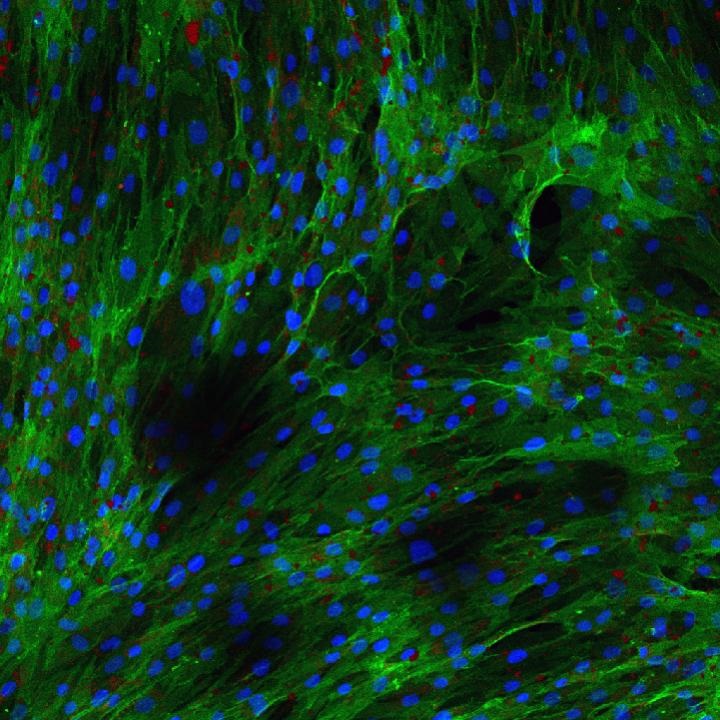
Image: Human stem cells stained in green color. Image courtesy of Prof. John R. Bracht.