Pandoraviruses are a family of giant viruses that blur the line between the viral and cellular worlds. These amoeba-infecting viruses feature bacterium-like dimensions and genomes with eukaryote-like complexity. Pandoraviruses were first identified in 2013 with only two representative species. Now, the same discovery team has isolated three brand new strains, enabling new comparative genomic and proteomic studies. Published findings in Nature Communications on the evolution of these viruses come from a team led by Aix Marseille Université in France.
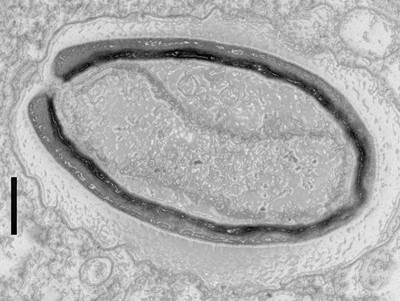 The team isolated new pandoraviruses from a range of locations: from ground soil in Marseille, France; from brackish water of a mangrove in New Caledonia; and from a freshwater pond near Melbourne Australia. New genomes were assembled from sequencing the purified particles.
In order to more accurately identify “real” genes and avoid overprediction when analyzing the new genomes, the team included strand-specific RNA-seq experiments and proteome analysis by mass spectrometry. Comparative bioinformatics on the three new strains and the original two revealed that, in addition to their large genome size of up to 2.5 Mb, these viruses only shared half of their protein-coding genes.
The new members contained a large number of orphan genes—genes that have no equivalent in other organisms. This was something previously observed in the first two pandoraviruses. Surprisingly, the orphan genes also differed from one pandoravirus to another, making it less likely that they were inherited from a common ancestor—and more likely to be new.
A closer look at the orphan genes revealed features that were very similar to those of non-coding, or intergenic, regions in the pandoravirus genome. Based on the locations of these new orphan genes, the team has suggested that pandoraviruses must have been spontaneously and randomly creating new genes, a eukaryotic process known as de novo gene creation.
“De novo gene creation could contribute to the evolution of the giant pandoravirus genomes,” the team concludes in their paper. They add, however, that while the de novo creation hypothesis may sound seductive, this study is not yet enough to settle any debate.
Image: Pandoravirus quercus found in Marseille, France. Thin section, viewed via electron microscopy. Scale bar: 100 nm. Image courtesy of IGS- CNRS/AMU.