As the saying goes, “if you want something done right you have to do it yourself”. This was the philosophy behind the recent invention of the eVOLVER, a high-throughput, automated cell-culturing system that can run continuously for months and grow dozens of cultures simultaneously. The system was created when a Rice University researcher named Caleb Bashor realized he needed a novel solution to run the microbiology experiments he is interested in and was created as part of a multi-institutional, collaborative effort.
The necessity for the platform came when Bashor was working on the issue of antibiotic resistance as a postdoctoral researchers at Boston University (BU). He was seeking to understand how timing of antibiotic administration effects the emergence of resistance, a question that requires the kind of long-term, repetitive and prompt administration only available through automation. At the time, no off-the shelf device existed for such an experiment and combining standard bioreactors for such a set-up would have cost hundreds of thousands of dollars and entire rooms of space.
To create such a platform Bashor, along with other BU scientists, began designing electronics, fluidics, culture chambers and software to control the chambers and report results. Finding code to report, record and track all variables across all the time scales in each culture was challenging, but they eventually were able to repurpose a software originally designed to track stock prices.
As proof-of-principle the researchers used the system to individually vary the level of timing of temperature, media inputs and outputs, and other environmental factors in more than 450 yeast cultures for more than 500 hours. Continual reports were generated regarding the performance of each culture, allowing the researchers to gauge how particular yeast strains adapted to stress.
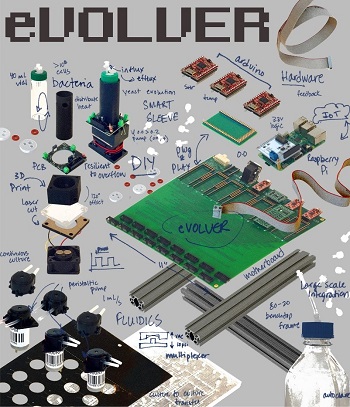
The prototype eVOLVER cost less than $2,000, cheaper than even a single continuous culture bioreactor and has three modules including a “smart sleeve” housing and interface for each culture vessel, a fluidic module for moving liquid in and out of the culture vessels, and a hardware infrastructure that simplifies the high-volume data flow by decoupling each parameter into individual microtcontrollers. More details can be found in their paper published in Nature Communications.
"The idea was to make it cheap, open source and totally customizable so that anybody could make it as long as they have access to a machine shop, a 3D printer and a McMaster-Carr catalog or RadioShack catalog," said Bashor.
Image: eVOLVER combines the control of automated, continuous cell-culturing systems with the scale of high-throughput systems that grow many cultures at once. Image courtesy of C. Bashor/Rice University.