In new research, scientists at Helmholtz Zentrum München and Ludwig-Maximilians-Universität München have shown that ion channels help mediate signals that allow stems cells in the brain to divide and mature into neurons with different roles. The team's paper was published last week in Cell Stem Cell.
"Neural stem cells in the brain can divide and mature into neurons and this process plays important roles in various regions of the brain—including olfactory sense and memory," explains Magdalena Götz, corresponding author of the paper. "These cells are located in what is known as the neurogenic stem cell niche one of which is located at the walls of the lateral ventricles*, where they are in contact with circulating cerebrospinal fluid."
The team shows that the flow of cerebrospinal fluid is a key signal for neural stem cell renewal. The work shows that brain stem cells are influenced by the fluid, not necessarily as a chemical, but as a physical signal.
"The whole mechanism is controlled by the ENaC [epithelial sodium (Na) channel] molecule," lead author David Petrik explains."We were able to show in an experimental model that brain stem cells are no longer able to divide in the absence of ENaC. Conversely, a stronger ENaC function promotes cell proliferation." ENaCs are channel proteins found on cell surfaces where sodion ions pass into the cell's interior.
Additional tests showed that the shear forces exerted by the cerebrospinal fluid increased the function of ENaC. The physical stimulation causes the channel protein to be open for longer, allowing more sodium ions to flow into the cell to stimulate division.
 "The results came as a big surprise since ENaC had previously only been known for its functions in the kidneys and lungs," says Götz. Their team's future plans include exploring the fast signals mediated by ions in stem cells and clarifying to what extent the findings are relevant to therapies.
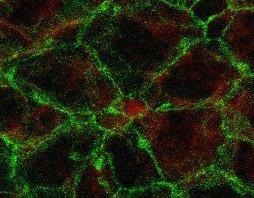
Confocal Microscope Image: Pin-wheel structure of the lateral wall of the lateral ventricle: ENaC-positive adult neural stem cell (red) surrounded by ependymal cells. Image courtesy of Helmholtz Zentrum München.
*The ventricular system is a set of four interconnected cavities (ventricles) in the brain, where the cerebrospinal fluid (CSF) is produced.