Not everything is invincible. After a long battle, even T cells become exhausted and in this new study, researchers from the University of Pennsylvania have found that there are nine distinct sets of exhausted T cells (Tex). The work was published yesterday in Immunity.
"Exhausted T cells are a discrete cell lineage that have become important immunotherapy targets for chronic infection and cancer," said senior author John Wherry, Ph.D. "Now, we know that exhausted T cells are a vastly diverse set of immune cells."
When T cells become exhausted, they develop defects in their fighting capabilities and express inhibitory receptor proteins that stop certain biochemical pathways, drive changes in control of gene expression, alter metabolism for making energy to fight infections and tumors, and prevent the development of optimal immune function.
Currently, some highly effective melanoma immunotherapies target the inhibitory receptors expressed by Tex, which have been implicated in the response to checkpoint blockade drugs in animal models. According to the authors, the immunological mechanisms of their response is now being studied in earnest.
"Exhausted T cells are quite diverse, as are all types of T cells," Wherry said. "This sheer diversity is the hallmark of the human immune system that has to essentially have a way to respond to every germ an individual might encounter in a lifetime."
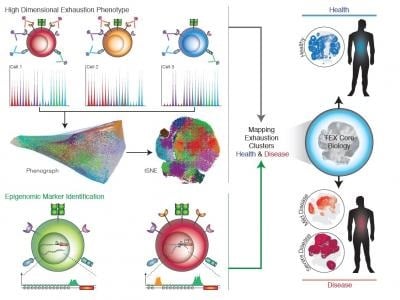
So the team questioned, what does the Tex population look like? They developed an assay to look at the molecules that control Tex gene expression and compared them to other T cells and within a Tex population in blood from HIV patients.
The team then lied out core exhaustion-specific genes and identified Tex populations that underwent diseased-induced changes. By doing this, they were able to define Tex cells into one of nine populations based on expression patterns in regards to transcription factors and inhibitory receptors.
 "We want to be able to select and tailor immune therapies according to a patient's exhausted T cell pool and its individual characteristics," Wherry said.
The team is hoping that by applying this kind of selection assessment, recommending which immunotherapies would be ideal for a patient will be easier and turn out more effective results.
Image: Exhausted T cells have poor function in chronic infections and cancer but can be therapeutically re-invigorated. Image courtesy of John Wherry, Perelman School of Medicine at the University of Pennsylvania; Immunity.