Researchers from the Kitasato University School of Allied Heath Sciences have found a new biomarker that could be used as an early indicator of lung cancer. The work was published yesterday in The American Journal of Pathology.
In this new study, researchers discovered high levels of cytoskeleton-associated protein 4 (CKAP4) in the blood of patients with lung cancer. They then found that the high levels of CKAP4 were found in patients with stage I disease, showing that it can be used as a noninvasive early indicator of lung cancer.
"The identification of patients at an early stage of cancer when it can be treated surgically is extremely important to improve prognosis," explained study leader Yuichi Sato. "We need better biomarkers for early diagnosis."
According to co-investigator Ryo Nagashio, a number of the current biomarkers for lung cancer are not sensitive enough to detect tumors early. "The results of our study provide evidence that the CKAP4 protein may be a novel early serodiagnostic marker for lung cancer."
To come to their findings, the researchers performed reverse-phase protein array analysis using a monoclonal antibody designated as the KU-Lu-1 antibody on the blood of 271 lung cancer patients and 100 healthy individuals. They found that KU-Lu-1 reacted only with the tumor samples and not the normal samples. To confirm that KU-Lu-1 did recognize CKAP4, the group used immunoprecipitation and mass spectrometry and indeed was able to confirm. They even were able to confirm this recognition in the culture supernatant. To top it off, the researchers had a validation set of samples from 100 patients with lung cancer and 38 healthy controls to study.
Other serum biomarkers are reported to have 17 to 52 percent sensitivity. The sensitivity of CKAP4 was 84 percent in the training set and 69 percent in the validation set, which are both higher than other serum biomarkers.
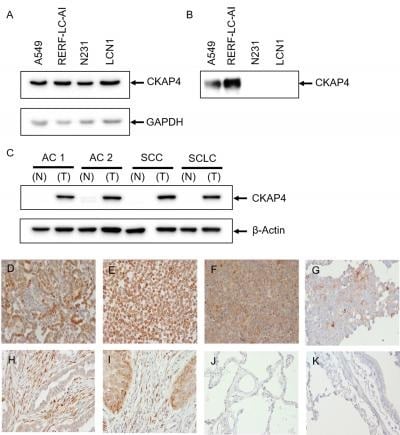 "The use of CKAP4 as a biomarker could change current practices regarding the treatment of lung cancer patients, and the diagnostic accuracies may be markedly improved by the combination of CKAP4 and conventional markers," concluded Sato.
Image: Immunoblot analysis using anti-CKAP4 antibody with whole-cell lysates from A549, RERF-LC-AI, N231, and LCN1, and lung tissue samples. A) CKAP4 protein is detected at approximately 63 kDa in all lung cancer cells. B) CKAP4 protein is also detected at approximately 63 kDa in culture supernatants of A549 and RERF-LC-AI cells. C) The CKAP4 protein is expressed only in lung cancer tissues, and not in their normal counterparts. T: tumor tissue, N: normal lung tissue. CKAP4 was observed at various intensities in the cytoplasm of lung cancer cells (D: A549, E: RERF LC-AI, F: N231, G: LCN1) and tissues (H: AC, I: SCC), but not in normal lung epithelium (J: alveolar epithelium, K: bronchial epithelium). Image courtesy of The American Journal of Pathology.