A research team has developed a new PET (Positron Emission Tomography) tracer that identifies an inflammatory protein found in individuals with rheumatoid arthritis (RA). The radiolabeled ligand, fluorine-18 (18F)-FEDAC, enables clinicians to visualize joint inflammation and could potentially be used to detect the disease in early stages before symptom onset. The study was published in The Journal of Nuclear Medicine.
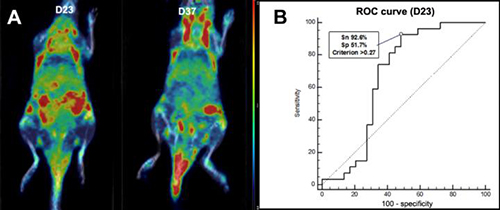 Macrophages, an immune cell that fights against foreign invaders such as bacteria and viruses, are known to be an active player in RA development. In the study, 18F-FEDAC targets and binds to translocator protein (TSPO), which is highly expressed in activated macrophages. The researchers tested the radiolabeled ligand in a mouse model of RA using PET imaging and examined the tissues microscopically to analyze macrophage abundance and TSPO expression.
The results showed that TSPO mRNA and protein expression was increased in activated macrophages and that uptate of 18F-FEDAC was higher in activated vs. non-activated cells. Additionally, joints from individuals with RA demonstrated a higher uptake of 18F-FEDAC on day 23, much earlier than the controls. This initial study suggests that PET imaging with 18F-FEDAC could be useful tool for clinicians diagnosing RA by enabling them to visualize active inflammation in arthritic joints before other symptoms develop.
Gi Jeong Cheon, MD, PhD explains, "Early treatment can reduce the progression of joint destruction and enhance the effect of disease-modifying antirheumatic drugs or target drugs, because the burden of inflammatory reaction is smaller in the very early phase of RA."
Image: (A) On day 23 and day 37, increased uptake is noted in the front and hind paws of this mouse with collagen-induced arthritis. (B) Predictive performance of day 23 18F-FEDAC uptake for the development of clinical arthritis. ROC = receiver operating characteristic; Sn = sensitivity; Sp = specificity. Image courtesy of Seoul National University and Ewha Womans University, Seoul, South Korea.