By developing a partial brain model from stem cells, Salk Institute scientists have been able to take a closer look into how neuron communication is disrupted in the brains of people with schizophrenia. Their work was published yesterday in Cell Stem Cell.
"In a lot of psychiatric diseases, there's evidence of dysfunction in the connections between cells," says senior author Rusty Gage. "But it's been very difficult to study the functional connections between human neurons in the lab, until now."
According to Gage’s team, previously if researchers wanted to study the molecular mechanisms of a disease like schizophrenia, they would only be able to look at one type of brain cell at a time and then look to see if gene or protein levels were altered or how signaling pathways were disrupted.
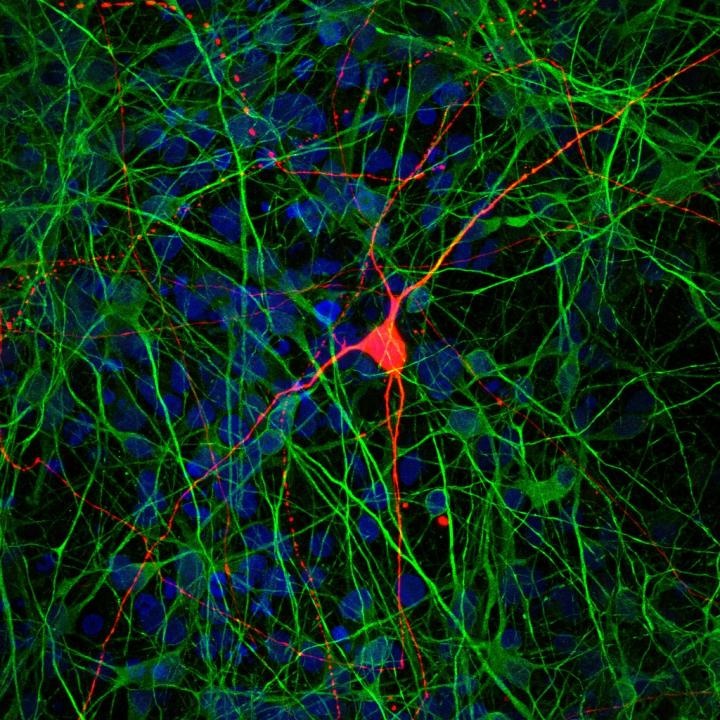
Previously, the team developed a method for using human stem cells to create dentate gyrus (DG) neurons that have been associated with a number of psychiatric diseases. In this current work, they have found a way to create CA3 pyramidal neurons, which receive signals from DG neurons. By doing this, the team was able to see that the CA3 neurons were not all the same. They actually are pretty diverse from each other.
"We weren't just getting one type of CA3 neurons," says Anindita Sarkar, the paper's first and co-corresponding author. "We were getting a mixture that is a close representation of the mixture we see in a human brain."
The team then mixed the CA3 neurons with DG neurons to see how they interacted. With a method known as virus tracing, they found that the CA3 neurons were forming physical connections with other CA3 neurons and DG neurons.
Being able to see these connections be made was a powerful finding. So the group decided to study cells from people with schizophrenia and those without schizophrenia. They then turned these cells into stem cells, which they then generated DG and CA3 neurons from them. While watching the neurons mature, they found that the CA3 neurons generated fewer spikes of activity. They also saw the same thing when they mixed the DG and CA3 neurons, meaning that there was less activity and less signaling occurring.
"There's been evidence that the hippocampus and DG cells are affected by schizophrenia," says Sarkar. "So it makes sense that if DG cells are affected, they're sending fewer signals to CA3 cells."
Gage’s group would like to add additional cell types to their model in the future and study neuronal connections in other diseases.
 "I think this is the next step in disease modeling with stem cells," says Sarkar. We've been doing well looking at individual cells over the last 10 years, but with this whole set of psychiatric diseases--from depression to autism to schizophrenia--we have to look at the connections, as well."
Image: Salk researchers used stem cells to derive CA3 pyramidal neurons (green), including a rare subtype of the cells (red). Image courtesy of the Salk Institute.