Plants can communicate through complex and hidden chemical signals underground, facilitated by the roots. A recent study reveals that this underground communication can happen as a direct response to above-ground stimuli. Corn seedlings that grow close enough to physically touch appear to release root-based signals for others to keep away. This published work in PLOS ONE comes from a team at the Swedish University of Agricultural Sciences.
The team designed an experiment in which maize plant leaves were touched briefly to mimic the natural stimulation from close neighboring plants. Using a hydroponic growing system, the team was able to collect any secretions coming from the roots of these plants. New seedlings were then grown with access to two different growth solutions: one from previously touched plants, and one from untouched controls.
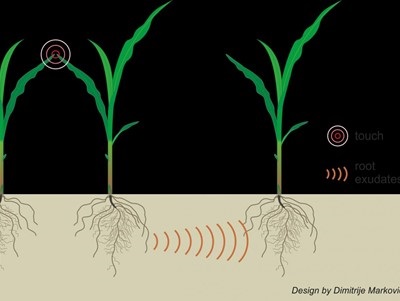 The team found that the maize seedlings grew significantly more often towards the solution from the control plants that were not touched. This suggested that roots have the ability to recognize different growth solutions. The team also tried directly transferring seedlings into the growth solution of previously touched plants to see what happens. Interestingly, these plants responded by focusing the growth of their biomass towards the formation of shoots rather than roots. This type of response appears to suggest growing behavior that avoids encroachment of nearby plants.
Root secretions were analyzed by ultra high-performance liquid chromatography-mass spectrometry (UHPLC-MS), but there were no significant differences observed. The team suspected that concentrations of components may have been too low for detection.
"Our study demonstrated that changes induced by above ground mechanical contact between plants can affect below ground interactions, acting as cues in prediction of the future competitors,” said study senior co-author Velemir Ninkovic.
Image: Graphical illustration of above ground interactions between neighboring plants by light touch and their effect on below-ground communication. Image courtesy of Elhakeem et al (2018).