A noninvasive brain tumor biopsy technique is being developed by a team of researchers from Washington University in St. Louis. According to the team, this simple blood test could potentially eliminate the need for surgical biopsy.
The blood brain barrier has been a significant obstacle to the development of a noninvasive method to detect brain tumor biomarkers. However, Hong Chen, a biomedical engineer, and Eric C. Leuthardt, a neurosurgeon, say they have found a way to release tumor-specific biomarkers—in this case, messenger RNA (mRNA)—from the brain into the blood. Results of their study, which blends imaging, mechanobiology, genomics, immunology, bioinformatics, oncology, radiology, and neurosurgery, were published today in Scientific Reports.
"I see a clear path for the clinical translation of this technique," said Chen, an expert in ultrasound technology. "Blood-based liquid biopsies have been used in other cancers, but not in the brain. Our proposed technique may make it possible to perform a blood test for brain cancer patients."
The blood test would reveal the amount of mRNA in the blood, which gives physicians specific information about the tumor that can help with diagnosis and treatment options.
The team tested their theory in a mouse model using two different types of glioblastoma brain tumor. They targeted the tumor using focused ultrasound, a technique that uses ultrasonic energy to target tissue deep in the body without incisions or radiation. Once they had the target—in this case, the brain tumor—researchers then injected microbubbles that travel through the blood similar to red blood cells. When the microbubbles reached the target, they popped, causing tiny ruptures of the blood-brain barrier that allows the biomarkers from the brain tumor to pass through the barrier and release into the bloodstream.
"In many ways this has been a holy grail for brain tumor therapy," Leuthardt said. "Having the ability to monitor the changing molecular events of the tumor in an ongoing way allows us to not only better diagnose a tumor in the brain, but to follow its response to different types of treatment."
"Once the blood-brain barrier is open, physicians can deliver drugs to the brain tumor," Chen said. "Physicians can also collect the blood and detect the expression level of biomarkers in the patient. It enables them to perform molecular characterizations of the brain tumor from a blood draw and guide the choice of treatment for individual patients."
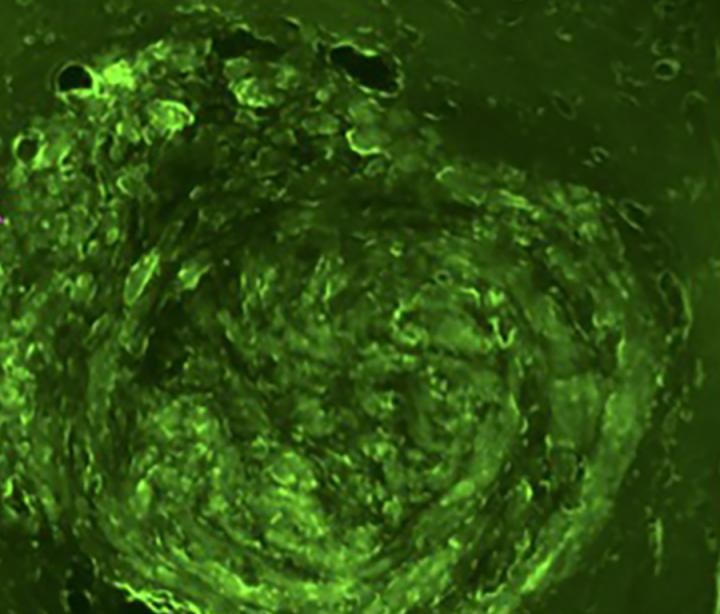
Image: A team of engineers and physicians at Washington University in St. Louis have developed a technique that may allow physicians to retrieve biomarkers from a brain tumor through a simple blood test. This image shows a brain tumor in a mouse that has been treated with green fluorescent protein-transduced glioblastoma cells. Image courtesy of Washington University in St. Louis.