Hypokalemic periodic paralysis is a rare genetic disorder caused by a mutation in the voltage-gated sodium channel protein Nav1.4 in skeletal muscles. The defect causes sodium ions to "leak out" even when the channels are closed. As a result, nervous system signaling through electric potentials are disrupted and paralysis develops. To date, there exists no reliable medicinal drug to cure all cases of the disease.
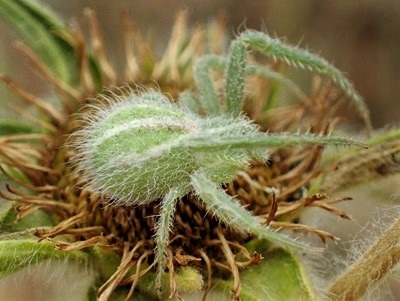
A promising mode of treatment comes from an unlikely source—the crab spider Heriaeus melloteei. New findings have shown that the spider toxin known as Hm-3 can be used to block the leaky channel. The work, published in PNAS, comes a collaboration between researchers from Lomonosov Moscow State University, the Russian Academy of Sciences, the UCL Institute of Neurology and Johns Hopkins University.
 “These mutations lead to a severe disease, type 2 hypokalemic periodic paralysis. We are the first to prove that there are natural chemical compounds able to block the leakage currents through mutated channels," explained Mikhail Petrovich Kirpichnikov, a co-author of the study.
The team studied the toxin interaction with mutant ion channels using protein engineering and electrophysiology within a Xenopus laevis oocyte expression system. Then by NMR spectroscopy and computer modeling, they were able to obtain key structural information. They found that Hm-3 groups into clusters and complexes with the voltage-sensing domain (VSD) of the ion channel through electrostatic and hydrophobic interactions. By binding, the toxin had effectively fixed the voltage-sensing domain of the channel in a position that prevented leakage of ions.
"The discovery of this toxin property gives us hope of developing efficient medicinal drugs for the treatment of patients with hypokalemic paralysis and other similar diseases,” reports Alexander Vasilevskiy, a senior co-author. “The model of interaction between the channel and the toxin gives us prospects for the development of new drugs."
Image: Heriaeus melloteei is a member of the Thomisidae crab spider family, known for ambushing unsuspecting insects. They are not generally not known to be harmful to humans. Image courtesy of Siga, Wikimedia Commons.