There are currently two main forms of male contraception: condoms or vasectomies. A new compound now in the works may offer a third alternative, with the added benefit of being non-hormonal. EP055 is a small organic molecule that aims to slow down the mobility of sperm, making them ineffective. The work on this candidate drug is published in PLOS ONE and comes from researchers at the University of North Carolina at Chapel Hill and Oregon Health & Science University.
 "Simply put, the compound turns-off the sperm's ability to swim, significantly limiting fertilization capabilities. This makes EP055 an ideal candidate for non-hormonal male contraception," said study first author Michael O'Rand, retired professor and CEO of Eppin Pharma, Inc.
EP055 targets the protein EPPIN, expressed on the surface of human spermatozoa. In previous studies, blocking EPPIN with antibodies has resulted in a loss of sperm cell motility, establishing this protein as a promising target for contraception.
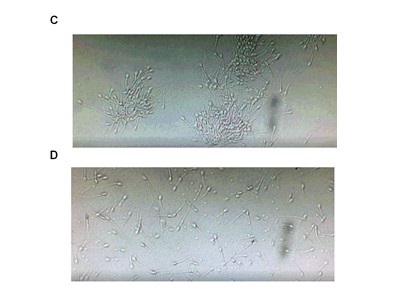
The team administered a high-dose intravenous infusion of EP055 in male rhesus macaques to test its efficacy. They observed a 20 percent reduction in normal sperm movement 6 hours after infusion. After 30 hours, normal sperm motility was completely wiped. No physical side effects were observed and the effects on sperm were not permanent. After 78 hours, sperm motility began to recover.
"At 18 days post-infusion, all macaques showed signs of complete recovery, suggesting that the EP055 compound is indeed reversible," revealed senior co-author Mary Zelinski.
More work is needed before EP055 can be tested in humans. For now, the team has begun to test the drug in a pill format. They are also pursuing a mating trial for a more accurate measure of the contraceptive true effectiveness.
Image: Photograph of sperm at 28–30 hrs after the high dose showing clumping (C) and after 18 days during recovery (D). Image courtesy of Michael O’Rand and PLOS ONE.