Single-cell RNA sequencing (scRNA-seq) is a widely used next gen sequencing technique to identify single cell types in a tissue or organ. This technology uncovers known and new cell types but does not reveal where the cells come from or the lineage of the cells. A paper published in Nature Biotechnology describes a new tool developed at the Max Delbrück Center for Molecular Medicine in the Helmholtz Association (MDC) named LINNAEUS that combines scRNA-seq and computational biology to trace the origin of known and new cell types.
LINNAEUS (lineage tracing by nuclease-activated editing of ubiquitous sequences) uses genome editing to add a targeted cut to DNA which results in a repair, or scar, that gets passed on as cells divide and grow. Those scars are like barcodes or unique identifiers that can be used to trace a cell’s lineage. The research team used a CRISPR-Cas9 system to repeatedly cut a reporter gene, red fluorescent protein (RFP), in zebrafish embryos and the cells patched the repair before dividing. The patch is performed quickly resulting in mistakes leaving a genetic scar that’s inherited by daughter cells. The genetic scars are used to identify cells originating from a common ancestor.
Lineage trees were built from the scRNA-seq data mapping thousands of cell types and from the genetic scars showing the connections between the cells. As expected, many challenges were faced connecting the dots, for example, frequently occurring scars. "This is dangerous, because if the same scar sequence is created in both heart and brain cells, one might mistakenly assume that they have a common ancestor," says Dr. Jan Philipp Junker, leader of the study. So we had to know which sequences we couldn't trust and filter them out."
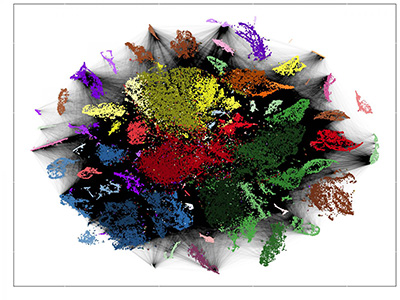 The final visual representation of the data includes lineage trees and color-coded pie charts where the braches divide. Scars indicate a division and different colors correspond to cell types. Researchers can zoom in on particular areas of interest in the large data set. The research team plans to continue studying zebrafish but sees the potential of applying the technology to humans in the future.
Image: Technologies such as RNA sequencing show which genes are translated in each individual cell. Using similar expression profiles, they were sorted by colour. The black lines symbolize a common origin of the cells. From these data, the researchers traced the cell lineages. Image courtesy of Junker Lab, MDC.