Follicular helper (Tfh) T cells are lymphocyte subtypes that help promote B cell differentiation and maturation for immunity. There exists a paradox in the context of HIV infections, in which Tfh are elevated in the lymph nodes, but B cell-driven humoral immunity remains impaired. From studying lymph tissue samples from patients with chronic HIV, a team identifies an anomaly among the follicular helper cells that shed valuable new insight on the fundamental nature of HIV. The recent work published in Science Immunology comes from a team led by researchers from University of Texas at Austin.
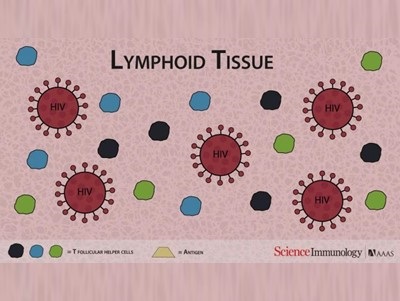 "These types of cells play a critical role during viral infections of any kind," said senior study co-author Jenny Jiang. "They communicate with other immune cells and provide instructions to B cells, for example, to produce virus-neutralizing antibodies that not only kill it off but also help prevent future infections."
From primary human lymphoid tissue samples extracted from HIV+ individuals, the team used high-dimensional mass cytometry and T cell receptor (TCR) repertoire sequencing to comprehensively profile the populations of Tfh cells. The results suggested that HIV infection changes the clonality of Tfh cells, with oligoclonal responses preferentially being more pronounced in severe infections. Functionally, these Tfh cells had a more dominant signature of interleukin-21 that was associated with aberrant B cell distribution. The team’s paper concludes that Tfh cells “remain capable of responding to HIV antigens during chronic HIV infection but become functionally skewed and oligoclonally restricted under persistent antigen stimulation.”
"We believe Tfh cells behave differently when fighting chronic infections like HIV versus when fighting off acute infections like the common cold, potentially making them an easy target for HIV," Jiang said. "Our next step is to determine why the Tfh cell dysfunction occurs in HIV-infected patients, moving us one step closer to better understanding the virus."
Image: HIV infection impacts the normal function of follicular T cell. Image courtesy of Carla Shaffer / AAAS.