While many technologies are available for analyzing the surface of solid samples, these are typically limited to smooth, planar surfaces. When it comes to irregular 3D objects, methods typically require manual sampling and a high degree of human intervention. In a new proof-of-concept study, a team designs a platform that combines the maneuverability and automation of a robotic arm and the analytical power of a mass spectrometer. This newfound freedom may have profound new applications in forensics and pharmaceutics. The research team from the Georgia Institute of Technology details their device in ACS Analytical Chemistry.
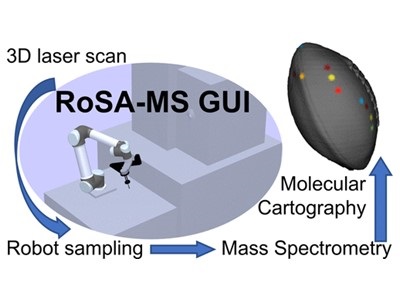 The platform is called Robotic Surface Analysis Mass Spectrometry, or RoSA-MS. As the team describes, the sampling probe is attached to a robotic arm that has 360° rotation through 6 individual joints. Also attached to the robotic arm is a 3D infrared laser scanner that generates a digital map of the sample surface. The map then directs the sampling probe to specific (x, y, z) locations, collecting trace amounts of material through a spring-loaded needle. Finally, the probe connects with an open port liquid sampling interface coupled to the electrospray ion source for mass spectroscopic analysis.
Through RoSA-MS, the team had been able to analyze a wide range of objects. For example, they detected caffeine on the surface of a plastic coffee cup and identified the locations of pesticide residue on a small football. The team concludes that RoSA-MS can produce chemical maps at the molecular level for applications “including the examination of food sample surfaces, lifestyle chemistry, and chemical reactions on curved substrates.”
Image: Schematic of the RoSA-MS analysis method. Image courtesy of Facundo M. Fernández and the American Chemical Society.