Elastin is the protein that gives strength to blood vessel walls and flexibility to skin. Decreasing levels of elastin are responsible for wrinkled sagging skin as people age. Being able to accurately measure elastin and better understand its role in biological processes is of obvious interest to anyone over 30. A new contrast agent has been synthesized that will facilitate the measurement of elastin, according to a team of scientists at the Institute for Basic Science (IBS). The team reports, in a paper published in Chem yesterday, that their dye could aid in the development of novel cosmetics as well as help verify the health of blood vessels and organs.
"Since elastin is located in the subcutaneous tissue, it is difficult to visualize with current methods. Moreover, it is a complex protein to work with as it has various forms, variable chemical linkages, and it is renownedly difficult to make a model for computational study. For the screening, we used intact elastin from throughout the whole body to avoid such problems," explains Chang Young-Tae, corresponding author of the study.
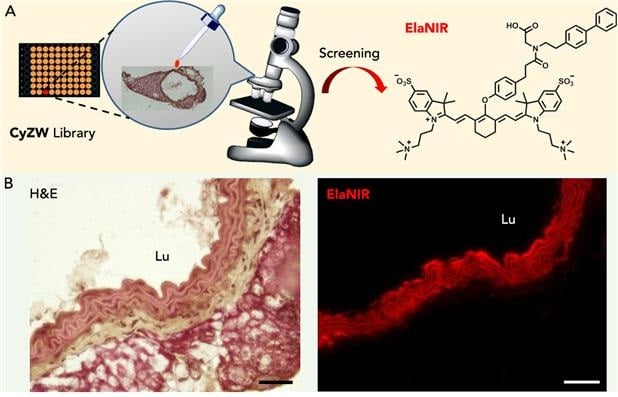
The near-infrared fluorescent contrast agent for elastin is called ElaNIR (Elastin Near-InfraRed). The method is based on near-infrared rays with wavelengths of 700-900 nanometers, which can reach elastin because of their excellent skin permeability. ElaNIR has an equal number of positive and negative charges within the same molecule, which has been shown to minimize non-specific binding to serum proteins, normal tissues, and organs, which provides cleaner images.
ElaNIR not only emits fluorescence at the near-infrared range, but also allows visualization of elastin-containing structures via photoacoustic spectroscopy. In photoacoustic imaging, the absorbed light energy is converted into ultrasonic sound, which can penetrate skin better than fluorescence. As a result, photoacoustics can provide higher sensitivity and higher spatial resolution in ElaNIR compared to fluorescence imaging. Thanks to this technique, the scientists were able to acquire 3D tomographies by detecting ultrasonic waves generated by absorbed near-infrared light.
When IBS scientists injected ElaNIR in old and young mice, the team was able to compare the amount of elastin in the skin. In the older rodents the amount of elastin was significantly reduced (1.8 times) compared to the younger ones. Using the photoacoustic technique, a high-resolution 3D tomographic image was obtained, which visually shows the distribution of elastin. Another promising feature of ElaNIR is its rapid removal from the system: more than 90% of the injected dose was cleared from the blood in four hours.
The team says it will provide ElaNIR for free to researchers seeking opportunities for collaboration or application.
Image: ElaNIR is a member of a library of fluorescent dyes that can emit near-infrared rays. It is a neutral molecule with two positive and two negative chemical groups. This features guarantees that it does not bind aspecifically to other biological molecules. B) ElaNIR highlights elastic layers, known as lamellae, in a rabbit's aorta. Image courtesy of IBS.