A team from the National Institute on Drug Abuse Intramural Research Program has found that G protein-coupled receptors (GPCRs) are more than just receptors and have very elaborate roles in the body. The work was published in Nature Communications yesterday.
Scientists have wondered how GPCRs operate. Are they isolated units that randomly collide with each other or do they deliberately work together to receive signals?
The group used different tools like fluorescent biosensors and computational models to uncover their findings that showed GPCRs form pre-coupled macromolecular complexes. In other words, they act as computing devices that gather and process information coming into the cell, which helps the cells adapt and change their function.
"These findings represent many years of complex and highly nuanced science, following the trail as chemical signals travel through the body at the cellular level," said NIDA Director Nora D. Volkow, M.D. "This remarkable discovery will open new avenues for medication development for addiction, pain and other conditions, offering more precise targets with fewer side effects."
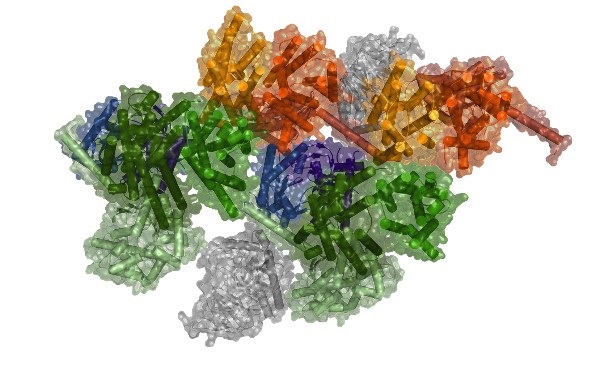 "The specific macromolecular complex investigated in this study has therapeutic implications not only for addiction but also for Parkinson's disease and schizophrenia," said Sergi Ferré, who led the team of scientists. "Discovering that these protein interact with other signals in preformed complexes gives us more precise targets for medication development."
Image: Computational model of a macromolecular complex. Image courtesy of the NIDA IRP and Sergi Ferré.