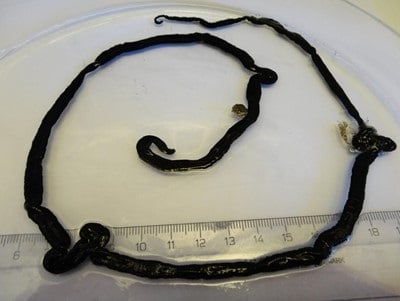
The longest animal in the world is the bootlace worm (Lineus longissimus), which can measure up to 55 meters. Apart from this ocean-dweller’s unique feat in length, it has also been found to produce a peptide neurotoxin that can kill both crabs and cockroaches. The findings, published in Scientific Reports, come from a team led by researchers from Uppsala University, Linnaeus University and the University of Agricultural Sciences.
 "This peptide toxin is the most poisonous substance to have been found in Sweden's animal kingdom and the fact that it may be possible to use it makes the discovery even more exciting,” says Ulf Göransson, senior co-author from Uppsala University. “We already know that peptide toxins are found in, for example, cone shells that live in tropical waters. These ribbon worms live in colder waters, for example, the coastlines of Great Britain and Norway and the west coast of Sweden."
L. longissimus, when irritated, releases large amounts of a thick mucus that is poisonous to crustaceans. From the mucus, the team identified the most abundant peptide through HPLC and LC-MS analyses. The peptide, the 31-residue toxin called α-1, was then isolated, synthesized, and structurally determined by 3D NMR.
As toxins often affect cellular ion channels, the team tested how α-1 inactivates sodium channels of various organisms. Experiments showed effectiveness on the German cockroach, fruit fly, and Varroa mite. α-1 also caused paralysis and death in the green crab, an invasive species. Tests on mammalian sodium channels proved not nearly as strong, and the team concluded α-1 as likely not poisonous to humans.
Similar neurotoxins that have been extracted from snakes, spiders and cone shells have already found use as pharmaceuticals, pharmacological tools, and agricultural insecticides. The team believes the bootlace worm toxin may find some use as well. "The peptide toxin has a very powerful effect on crustaceans and cockroaches, which is why it could serve as a very effective insecticide,” says Göransson.
Image: Lineus longissimus, a type of ribbon worm (phylum Nemertea), can reach 55 meters in length and 10 mm in width. Image courtesy of Erik Jacobsson.