Targeting PD-1/PD-L1, also known as checkpoint blockade immunotherapy, is emerging as a front-line cancer treatment. However, its success is limited by inadequate T-cell priming that depends on dendritic cell (DC) signaling. A team finds that stimulation of another receptor, CD27, can bypass DC signaling to synergize the effects of the checkpoint blockade. The pre-clinical study on this combination therapy is published in Clinical Cancer Research and comes from a team led by University of Southampton researchers.
 "Using checkpoint blockade has revolutionized the field of cancer immunotherapy, but it is not enough to simply stop the cancer from evading the immune system, we need to boost the immune system to fight the cancer off,” said study senior author Aymen Al-Shamkhani.
The team studied the efficacy of a dual-therapy that combines the PD-1/L1 blockade and an agonist anti-CD27 monoclonal antibody in multiple tumor models. Results showed the combination treatment produced up to 60 percent cancer protection in terms of increased CD8+ T-cell expansion and effector function. This was in comparison to only 10 percent protection when only the single treatment was given. Transcriptome analysis of CD8+ T cells also showed a type of division of labor induced by each type of therapy. Anti-PD-1/L1 activated a cytotoxicity-gene expression program whereas anti-CD27 preferentially augmented proliferation.
Finally, the team showed through clinically-relevant mouse experiments that an anti-human CD27 antibody, varlilumab, similarly synergizes with PD-L1 blockade for protection against lymphoma. These combination treatments activated different, yet synergistic pathways that resulted in stronger immune responses against the cancer.
“By combining checkpoint blockade with an anti-CD27 antibody, we have been able to show that the two approaches can be harnessed to potentially improve current treatment options," said Al-Shamkhani.
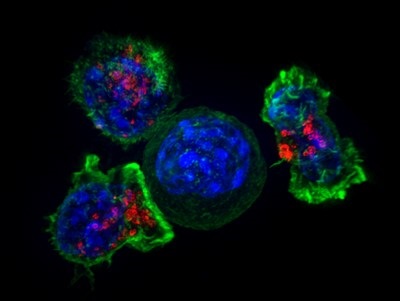
Image: Superresolution image of a group of cytotoxic CD8+ T cells (green and red) surrounding a cancer cell (blue, center). Image courtesy of The National Institutes of Health.