A computational microscope that can simulate the atomic and subatomic forces that drive molecular interactions has been developed by University of Illinois researchers. This tool will streamline efforts to understand the chemistry of life, model large molecular systems, and develop new pharmaceutical and industrial agents, the researchers report in a paper published in Nature Methods today.
Two different computational approaches used to simulate molecular interactions were combined to create this capability. The first, a nanoscale molecular-dynamics program known as NAMD, uses classical-mechanics methods to model the structure and simulate the behavior of hundreds of millions of individual atoms. The second program zooms in on the subatomic realm, simulating the interactions of protons, neutrons, and electrons.
Both molecular mechanics and quantum mechanics programs have been available for years, and other teams have worked to combine them, said University of Illinois chemistry professor Zaida Luthey-Schulten. But the new effort streamlines the process of setting up, performing and analyzing the simulations. "We set it up so that researchers can easily choose how they will partition their own systems," Luthey-Schulten added.
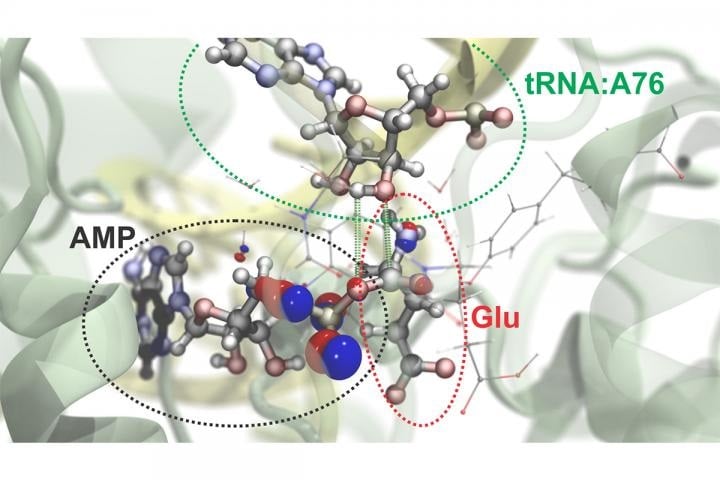
As a demonstration of the new approach, the researchers simulated the chemical behavior of transfer RNAs. Using NAMD, they modeled the overall molecular structure of tRNA at the moment that a special protein loads an amino acid to the tRNA. They partitioned two sites of the complex into regions requiring the more focused quantum mechanical approach.
The subatomic simulations of the interactions of the two regions allowed the team to run simulations of four different scenarios that would allow the tRNA to function as it does in the cell. Their simulations revealed that one of the four potential chemical pathways was more energetically favorable than the others and thus more likely to occur. The researchers also used various methods to partition the tRNA complex between the MM and QM regions and reported on each approach.
"We didn't pick just one way; we picked as many as possible. We give the user freedom. How you structure it really depends on the particular system you're studying," said Rafael Bernardi, a co-lead author on the study.
Image: Researchers can simulate atomic and subatomic dynamics in large molecular systems. Here is a visualization of the process by which the amino acid glutamate (Glu) is attached to a specific region of its transfer RNA (tRNA). An energy-rich molecule, ATP, drives this reaction and is converted to AMP in the process. The red and blue bubbles represent the probability of finding electrons in particular regions. Green dotted lines delineate the atoms that bond in this chemical reaction. Image courtesy of Rafael Bernardi, Zan Luthey-Schulten and Marcelo Melo.