A new screening test for early-stage endometrial and ovarian cancers has been developed by researchers at John Hopkins Kimmel Cancer Center. The screening tool combines genetic analysis of routine Papanicolau (Pap) samples with analysis of circulating tumor DNA. The researchers also demonstrated that using a Tao brush to obtain intrauterine samples can increase detection sensitivity for tumors that are not easily accessible. The paper was published in Science Translational Medicine
In 2017, more than 86,000 endometrial and ovarian cancers were diagnosed. Gynecological cancers, in general, result in approximately 25,000 deaths per year. Survival rate of individuals with gynecological cancers, especially ovarian cancer, tend to be low because tumors tend to metastasize before the onset of symptoms. PapSEEK, the newly developed screening test, targets both ovarian and endometrial cancers with the goal of detecting the cancers early when they are more responsive to treatment.
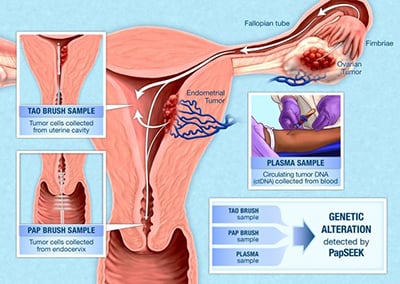 Fluid obtained from routine Pap tests contains endometrial and ovarian cells that the researchers analyzed to detect cancer cells in those organs. The study included 1,958 Pap smear samples from 1,658 women of which 658 had endometrial or ovarian cancer. The other 1,002 samples were healthy controls. Of the samples obtained with a pap brush from the cancer patients, PapSEEK was able to detect cancer nearly 99% of the time. Endometrial cancer was detected at 81% accuracy with 78% of those being early-stage cancers. Ovarian cancers were detected 33% of the time and 34% of those were early-stage cancers.
For samples collected using a Tao brush, a long, thin brush traditionally used for endometrial sampling, endometrial cancer was detected 93% of the time. Ovarian cancer from samples collected with a Tao brush were detected 45% of the time, much higher than in samples obtained with a Pap brush. When Tao brush sampling was combined with circulating tumor DNA analysis in plasma, sensitivity levels increased even more to 63% for ovarian cancer.
Better screening and diagnostic methods are urgently needed for gynecologic cancers because of their high mortality rate. "Our study demonstrates the ability to detect endometrial and ovarian cancer using cervical fluids obtained using two different methods," said Yuxuan Wang, first author on the study.
Image: Since fluid from the Pap test occasionally contains cells from the endometrium or ovaries, researchers found they could detect cancer cells from these organs that are present in the fluid by using different brushes. Image courtesy of Johns Hopkins University.