Scientists from the Champalimaud Centre for the Unknown have found that persistence is driven by serotonin. The work was published yesterday in Nature Communications.
First author Eran Lottem and colleagues developed a task that could simulate the situation when animals are foraging for food. This experiment helped them distinguish the difference between persistence and patience.
"We had some hints suggesting that the inhibitory effect of serotonin was not general. Some behaviors were unaffected by serotonin," says Lottem. "But we had never seen an active behavior promoted by serotonin. This is, to my knowledge, the first time such a behavior has been observed when serotonin-producing neurons are activated."
The researchers created a task where there were two drinking sites at each end of a long rectangular box. However, only one drinking site was available at a time so the mice would have to run from one end to another. The experimenters also made it so that if even a drinking site was available, it would not necessarily always work. The number of times the animals tried to get water from a drinking site that did not work was their way of measuring persistence.
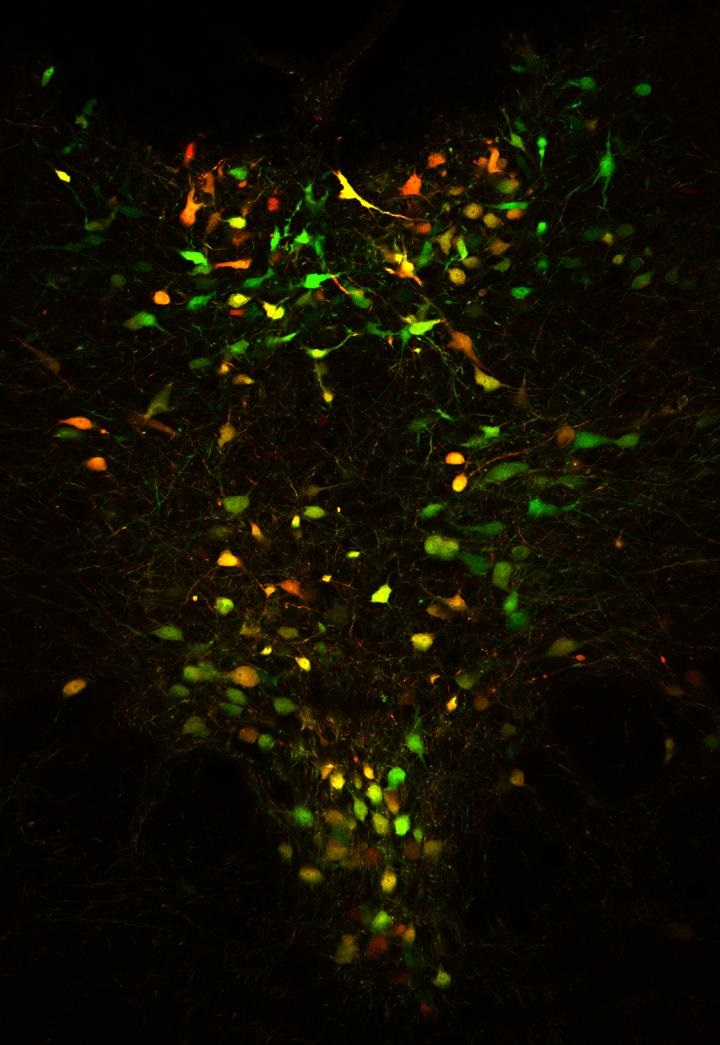
After creating the task, the team used optogenetics to stimulate the serotonin-producing neurons with pulses of light delivered by an optic fiber that was implanted to the animals' brain.
 "What we saw was that when those neurons were stimulated, the animals were willing to poke longer even when they were not getting water. Therefore, serotonin was not inhibiting their behavior because, in that case, the mice would have given up sooner," says Lottem. In other words, he concludes, "the activation of serotonin neurons promotes active persistence rather than mere patience."
The results from this study may help to understand how to treat depression, a disorder that serotonin is known to take a role in, notes lead author Zachary Mainen.
Image: Advanced techniques to directly control the activity of serotonin neurons in the brain are used to illuminate serotonin's biological functions. Image courtesy of Champalimaud Centre for the Unknown/Sara Matias.