A study from the Centro Nacional de Investigaciones Cardiovasculares Carlos III has revealed that by blocking protease MT4-MMP, blood-patrolling monocytes activity is increased. The findings were published last week in Nature Communications.
The team conducted their studies in an atherosclerosis disease model. When an injury signal occurs in atherosclerosis, a migration of inflammatory monocytes and patrolling monocytes occurs. Then, once the monocytes have reached their destination, they differentiate into macrophages, which engulf the injurious material. In this case, it is cholesterol.
"The first things we observed were that early atherosclerotic plaques in mice lacking MT4-MMP (a member of the matrix metalloprotease family) accumulated more macrophages and that atherosclerosis was accelerated when these mice were fed a high-fat diet," said Cristina Clemente, first author of the paper. They also saw that MT4-MMP deficient mice also lacked early lesions.
"Macrophages derived from the patrolling monocytes incorporated more fat and showed better survival than those derived from inflammatory monocytes," added Clemente.
So when the team treated the MT4-MMP deficient mice with a CCR5 inhibitor and the migration of patrolling monocytes to the plaques was blocked. The inhibition caused by CCR5 promoted atherosclerosis but prevented the recruitment of MT4-MMP-null patrolling monocytes to the atherosclerotic lesions.
 The result suggests that in order to boost patrolling monocyte activity, MT4-MMP targeting should be considered. This could increase the effect of the response to treatments to battle infection or stop metastasis. "We don't know if this acceleration of atherosclerosis is maintained at later stages, and this is something that will need to be analyzed," said research leader Alicia G. Arroyo.
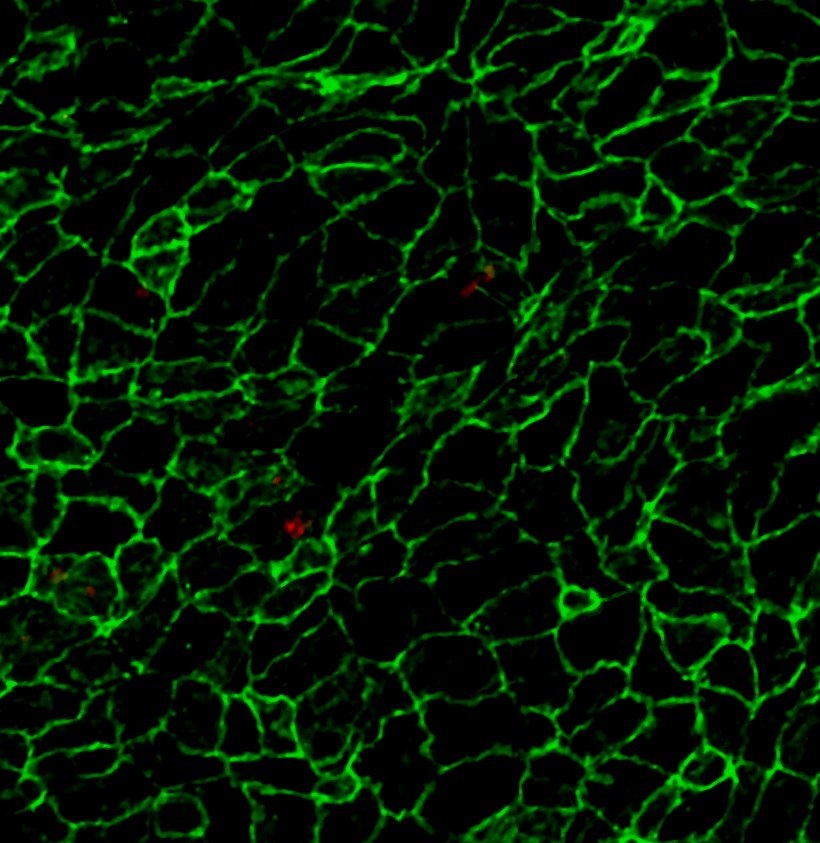
Image: Blood-patrolling monocytes (red) adhering to inflamed endothelium (green) in the inner curvature of the aortic arch of a mouse with incipient atherosclerosis. Image courtesy of CNIC.