Scientists from the Far Eastern Federal University (FEFU) have found that pesticides accumulate in bodies with high-fat content. The work was published in Marine Pollution Bulletin.
The researchers studied organochlorine pesticides (OCP) and how they build up in seabirds and marine mammals that live in the north-western part of the Pacific Ocean. OCP are highly toxic and accumulate in the fat tissue and internal organs.
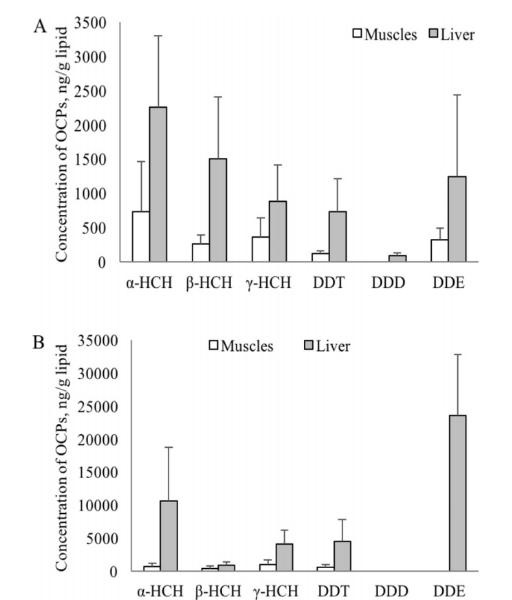
To study and identify the presence of OCP, the researchers used gas chromatography-mass spectrometry and found that OCP concentration was higher in the organs of seabirds and marine animals that had a higher fat content.
 The level of OCP accumulation in marine animals is a great indicator of the global environmental status. This data can help scientists determine the level of pesticide pollution in the ocean.
"Organochlorine pesticides are a serious threat for people, and the situation worsens with time. For example, due to the actions of China and India, the concentration of OCP in the Indian Ocean is constantly growing. The USA also produce pesticides for sale," says Kirill Golohvast, provost for research at FEFU.
Image: Concentration of selected OCPs in organs of gray whale (A) and Pacific walrus (B). Image courtesy of Vasilliy Tygankov.