Scientists from the University of Cambridge unveil how genetics can change the color and appearance of Flavobacterium, a type of bacteria that produces metallic colors, which come not from pigments, but from their internal structure. The study was recently published in Proceedings of the National Academy of Sciences.
"It is crucial to map the genes responsible for the structural coloration for further understanding of how nanostructures are engineered in nature," said first author Villads Egede Johansen. "This is the first systematic study of the genes underpinning structural colors—not only in bacteria but in any living system."
To learn more about the bacteria's genetics, the researchers used sequencing technology and compared wild-type and mutated bacterial colonies. When the team changed the bacteria's dimensions or their ability to move, the geometry and the color of the bacteria changed. Using electron microscopy, the team saw that bacteria went from a metallic green color to a whole different color. They were even able to make the color completely disappear.
"We mapped several genes with previously unknown functions and we correlated them to the colonies' self-organizational capacity and their coloration," said senior author Colin Ingham.
"From an applied perspective, this bacterial system allows us to achieve tuneable living photonic structures that can be reproduced in abundance, avoiding traditional nanofabrication methods," said co-senior author Silvia Vignolini. "We see a potential in the use of such bacterial colonies as photonic pigments that can be readily optimized for changing coloration under external stimuli and that can interface with other living tissues, thereby adapting to variable environments. The future is open for biodegradable paints on our cars and walls—simply by growing exactly the color and appearance we want!"
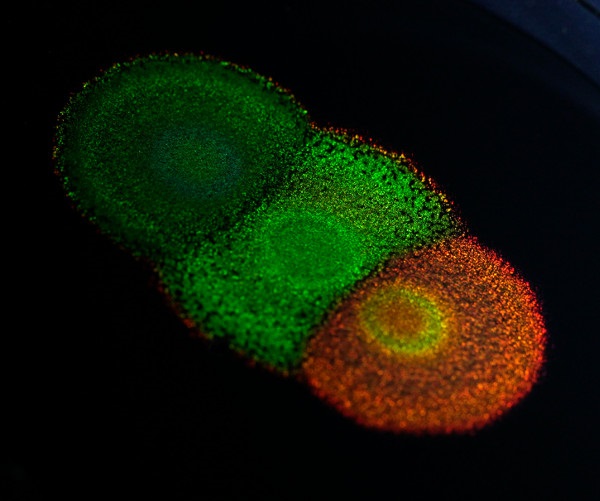 Image: A colony of the Flavobacterium IR1, 2 cm in diameter, growing on a nutrient agar plate. The cells in the colony are highly organized, thus forming a 2-D photonic crystal that interferes with light. This results in structurally colored bright and angle-specific hues with a concentric ring pattern indicating subtle changes in the organization. The older cells of IR1 in the colony center are more disorganized and therefore loses color. IR1 can be genetically modified from this wild-type strain to create new, living photonic structures.