A study has demonstrated the complete reversal of amyloid plaque development in Alzheimer’s disease (AD) adult mouse models by steadily increasing the inhibition of BACE1, an enzyme known to help produce plaques. The BACE1 gene encodes beta-secretase which helps produce beta-amyloid peptide, the molecule which aggregates to form amyloid plaques. The study findings, published in the Journal of Experimental Medicine, provide hope that a BACE1 inhibitor drug could reverse AD in humans.
In previously published studies, mice completely devoid of BACE1 did not develop normal neurological function. In order to study the impact of a gradual decrease in BACE1, the research team created mice through genetic engineering that steadily lost BACE1 activity over time. These mice developed normally and appeared to be healthy. The team then bred these mice with other mice that developed amyloid plaques around 75 days old. The offspring of these two types also developed plaques at 75 days but had half the amount of BACE1 levels of their parents, as expected. The researchers observed that as the offspring aged, their plaques began to disappear alongside a reduction in BACE1 levels. When the mice reached 10 months, the plaques could no longer be detected.
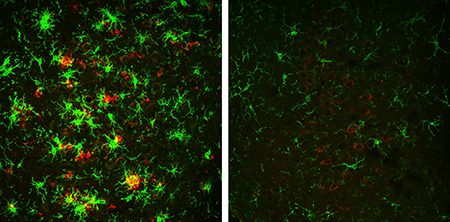 "To our knowledge, this is the first observation of such a dramatic reversal of amyloid deposition in any study of Alzheimer's disease mouse models," says Riqiang Yan, who will be moving to become chair of the department of neuroscience at the University of Connecticut this spring.
Reduced BACE1 activity also appeared to improve learning and memory in mice measured by a fear conditioning test which is commonly used to assess cognitive function in rodents. However, electrophysiological recording of neurons showed that synaptic function was still impaired meaning that certain levels of BACE1 might be required for normal cognition. Further studies are required to minimize the impact of BACE1 reduction on synaptic function. Overall, the study findings are an important contribution to the advancement of drug development for the treatment of Alzheimer’s disease in humans.
Image: The brain of a 10-month-old mouse with Alzheimer's disease (left) is full of amyloid plaques (red) surrounded by activated microglial cells (green). But these hallmarks of Alzheimer's disease are reversed in animals that have gradually lost the BACE1 enzyme (right). Image courtesy of Hu et al., 2018.