Tiny islands in the cell membrane of baker's yeast have been observed with state-of-the-art super-resolution optical microscopy. These membrane compartments appear to store transport proteins, which move extremely slowly in the plasma membrane of the yeast as they travel through the membrane to reach the islands. Details on the discovery were published in Nature Communications today by a team of microbiologists from University of Groningen.
“Electron-microscopy studies from the 1960s show depressions in the yeast membrane, but they were not studied in detail and were dismissed as artefacts of sample preparation,” explains Bert Poolman, professor of biochemistry. “Then, about ten years ago, these depressions were rediscovered. Scientists observed banana-shaped proteins attached to the inner side of the membrane, and they turned out to be responsible for these depressions, which were named eisosomes.”
By using different fluorescent markers to label both the transport proteins in the membrane and the proteins on the inner side, the Poolman group could determine which proteins were co-localized with the eisosomes. As the depression is only some 50 nanometers deep, and the eisosomes are a maximum of 150 by 100 nanometers in dimension, this required extremely high-resolution microscopy.
The studies revealed that some amino acid transporters are indeed preferentially localized in the eisosome. “But only when there is no substrate available,”explains Poolman. “If we add the right amino acid, the protein moves away from the eisosome, probably because it takes on a different conformation in the substrate-bound state.”His hypothesis is that the eisosomes protect the transport proteins from recycling.
The proteins are synthesized in the cell and then transported to the membrane by exocytosis. However, when they are not in an eisosome, these proteins are quickly absorbed again through endocytosis.”So, the transporters are transiently 'stored' in the eisosomes. When the appropriate substrates are present outside the cell, they move away to transport the amino acids into the cell until the proteins are no longer needed, after which they are recycled.
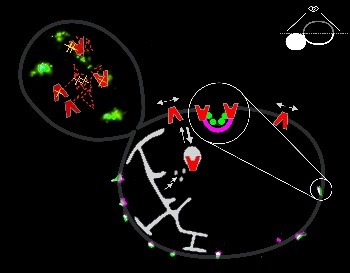
The Poolman group also assessed the speed of diffusion of the proteins in the yeast plasma membrane. They observed that this was about a thousand times lower than in mammalian cells or in the internal membranes of the yeast cell. “The yeast plasma membrane is more rigid. It can withstand relatively high concentrations of alcohol or acid. This apparently affects protein diffusion.”
The results of this study provide a better insight into the functioning of the yeast cell membrane in general, and more specifically the eisosome islands. They also provide new information on the biogenesis and trafficking of membrane transport proteins, which in time may improve the industrial productivity of yeast.
Image: Schematic of yeast cell, showing in green-pink the eisosomal structures in which transporters (red, V-shaped) are parked when the substrate is not available for the cell. It also depicts how transporters travel from the endoplasmic reticulum (ER, light grey) to the plasma membrane (dark grey). The top left part of the cell shows trajectories of individual transporters diffusing in the plasma membrane. Image courtesy of Frans Bianchi / University of Groningen.