A new study from scientists at the University of Freiburg and the Centre of New Technologies in Warsaw, Poland has discovered how mitochondria with impaired redox balance regulate the synthesis of new proteins in the cytoplasm. The mitochondria use reactive oxygen species as a signal to slow down the cellular protein synthesis process. The work was published recently in Nature Communications.
Using quantitative mass spectrometry, University of Freiburg researcher Ida Suppanz first determined the redox state of thiols in proteins of the baker's yeast, Saccharomyces cerevisiae. From the mass spectrometry data, she found unknown redox-active thiols in components of the ribosomes at which new proteins are synthesized.
Centre of New Technologies researcher Ulrike Topf showed that damaged mitochondria can signal their metabolic state to the protein synthesis machinery via reactive oxygen species and, thereby, slow down cellular protein synthesis. The scientists assume that the temporary reduction of the protein synthesis rate under oxidative stress has a positive effect on the survival of the cells and helps to restore homeostasis. This also prevents a build-up of newly synthesized proteins in the cytoplasm that can't be taken up by the damaged mitochondria.
 The researchers believe that their findings on how dysfunctional mitochondria communicate with other cellular components can help elucidate the mechanisms of age-related and neurodegenerative diseases in the future.
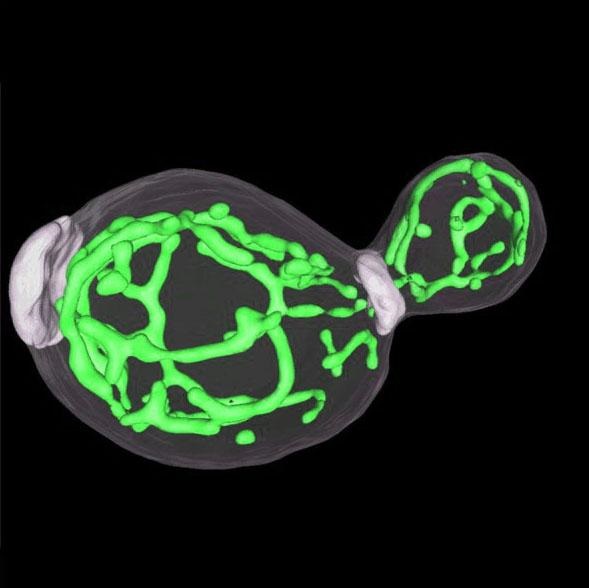
Image: 3-D-structure of mitochondria in a budding yeast cell. Labeling with a green fluorescent protein shows that mitochondria form a tight tubular network in the cell.