Metabolites comprise a large fraction of molecules in cells, but compared to our understanding of protein-protein or protein-DNA interactions, our knowledge of the metabolite-protein “interactome” still lags behind. A research team from ETH Zurich in Switzerland have thus taken interactomics to the next level by biochemically mapping global interactions between proteins and metabolites.
 In their published report in Cell, the team investigated how many of the proteins and enzymes present in E. coli interact with a given set of metabolites. To do this, E. coli protein lysates were mixed with a metabolite to allow for protein interaction. Finally, a protease is added to biochemically measure the interactions. In total, the team tested 20 different metabolites.
When a protein interacts with a metabolite, whether it settles in the protein's active site or attaches to another site, the protein structure is altered. The structural change affects the protease cut sites, resulting in a different set of digested peptides. This approach, known as limited proteolysis (LiP), is then followed up with mass spectrometry to generate proteolysis fingerprints and quantitative proteomic data. Further analysis also enables the reconstruction of the structural differences and changes, as well as cellular localization.
With this method, the team produced a metabolite-protein interactome of 1,678 interactions and 7,345 putative binding sites. Of the interactions, over 1,400 were previously unknown. "Although the metabolism of E. coli and associated molecules is already very well known, we succeeded in discovered many new interactions and the corresponding binding sites," says Paola Picotti. "The data that we produce with this technique will help to identify new regulatory mechanisms, unknown enzymes and new metabolic reactions in the cell."
Among other findings, the team found that small metabolic molecules have a binding preference for proteins with concentrations that are generally constant. Protein-metabolite binding and protein concentrations may thus be two complementary pathways in the cellular regulation of protein activity. The findings also shed light on enzyme promiscuity, as they can apparently bind to and chemically alter several different metabolites.
The method has clear pharmaceutical applications. Researchers can study which proteins and which sites a drug may bind to, and as a result, how structure and activity may be influenced. The method is now patented by ETH spin-off Biognosys, who has the exclusive license.
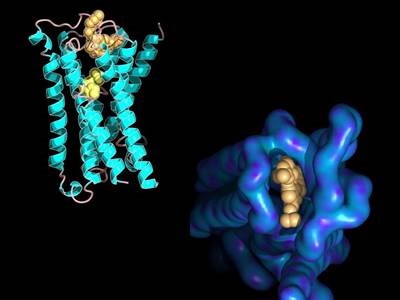
Image: Molecular model of a protein membrane receptor bound to its small molecule ligands with structural details of the allosteric binding site (right). Image courtesy of Ilaria Piazza / ETH Zurich / PDB database entry 4MQT.