A novel lab-on-a-chip that can be used to study gene regulation in single bacterial cells in response to dynamically controlled environmental changes has been introduced by researchers at the Biozentrum of the University of Basel, in collaboration with the Max Planck in Dresden. The integrated system was outlined in Nature Communications earlier this month.
The miniature lab is about the size of a matchbox. Single bacterial cells grow in about 2,000 channels of a thousandth of a millimeter in diameter and can be individually studied in detail. By recording thousands of microscopic images at short time intervals, the precise growth and behavior of many generations of individual E. coli bacteria can be tracked over several days, for example.
Using the new system the researchers can now study how genes are regulated in single cells under changing environmental conditions. This way, they not only gain insights into gene regulatory processes but also an overview of the diversity of adaptive responses of bacteria to varying environments. For example, it is possible to investigate how individual bacterial cells respond to a sudden exposure to an antibiotic: whether they die, stop growing, or simply continue to divide undisturbed.
"With the microfluidic chip we can also answer, how bacteria communicate with each other, how they respond to stress, or whether the relationship of bacterial strains plays a role in adaptation strategies," says van Nimwegen. "Such single-cell analyses are very important, because measurements of entire cell communities are often misleading since all the heterogeneity of the single cells has been averaged out."
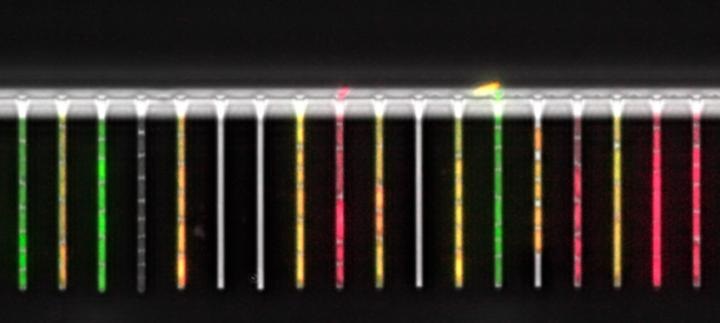
The researchers demonstrated the efficiency of the chip laboratory using a model system of gene regulation, the Lac-Operon. "We have used green fluorescent protein to observe how E. coli bacteria respond to alternating nutrient changes from glucose to lactose. The Lac-Operon has been studied for more than 50 years, and still, we discovered new important properties when looking at it with single-cell resolution," says van Nimwegen.
This system is suitable for a wide range of applications. All relevant information on chip design and experiments, MoMA software for image analysis, as well as the raw data acquired in this study are openly available online.
Image: A microfluidic system for tracking growth and gene expression of single bacteria. Image courtesy of University of Basel, Biozentrum.