Arc is a protein well-understood to be essential for long-lasting information storage in the mammalian brain. Previous work has shown that mice without Arc lacked neuronal plasticity and also forgot things they had learned a mere 24 hours earlier. New findings by a University of Utah-led team on Arc function now reveal that it mediates neuronal RNA transfer—surprisingly—in a virus-like manner.
"At the time, we didn't know much about the molecular function or evolutionary history of Arc," says principal study author Jason Shepherd, who has researched the protein for 15 years. "I had almost lost interest in the protein, to be honest. After seeing the capsids, we knew we were onto something interesting."
 Earlier crystal structures of Arc had revealed an architecture that was remarkably similar to the capsid domain of the HIV gag protein. From this, Shepherd and his team confirmed that regions of the code were indeed similar to those that from viral capsids. Evolutionary analysis indicated that Arc is derived from a vertebrate lineage of Ty3/gypsy retrotransposons, ancestors to retroviruses.
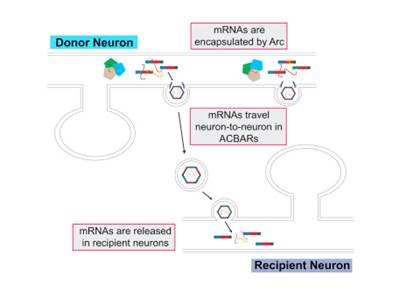
To test if function followed structure, the team designed a set of experiments to test whether Arc functions similarly to viruses. They find that several copies of Arc self-assemble into hollow virus-like extracellular vesicles that encapsulate mRNA, including its own. When these capsids are purified and transferred to mouse neuronal cells in culture, they are subsequently endocytosed, transferring the Arc mRNA into the neuronal cytoplasm.
"We went into this line of research knowing that Arc was special in many ways, but when we discovered that Arc was able to mediate cell-to-cell transport of RNA, we were floored," says the study's first author, Elissa Pastuzyn. "No other non-viral protein that we know of acts in this way."
The team’s paper, published today in Cell, concludes that regarding Arc function, “Gag retroelements have been repurposed during evolution to mediate intercellular communication in the nervous system.”
Surprisingly, this instance of viral gene repurposing of Arc is observed elsewhere in the history of evolution. The Drosophila version of Arc, which also evolved from the same class of retrotransposons, now functions to transport RNA from neurons to muscles to control movement.
Image: Graphical abstract depicting mRNA encapsulation by Arc and transport to recepient neurons. Image courtesy of Jason Shepherd / Elsevier Cell.