There are approximately 42 million protein molecules in a simple cell, according to a recent study by researchers from the University of Toronto's Donnelly Centre for Cellular and Biomolecular Research. By analyzing data from over twenty protein abundance studies in yeast cells, the team was able to produce reliable estimates for the number of molecules for each protein. The research was published this week in Cell Systems.
The work was partly motivated by curiousity,“given that the cell is the functional unit of biology, it's just a natural curiosity to want to know what's in there and how much of each kind," explained Grant Brown, a biochemistry professor and leader of the study, who conceded that another motivating factor is that many diseases are caused by either having too little or too much of a certain protein. The more scientists know about how protein abundance is controlled, the better they'll be able to fix it when it goes awry.
Protein abundance has been studied for years but because findings were reported in arbitrary units, it has been hard to compare data between different labs. Many groups, for example, have estimated protein levels by sticking a fluorescent tag on protein molecules and inferring their abundance from how much the cells glow.
"It was hard to conceptualize how many proteins there are in the cell because the data was reported on drastically different scales," said Brandon Ho, graduate student in the Brown lab who did most of the work on the project.
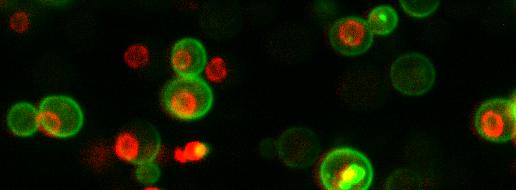
To convert arbitrary measures into the number of molecules per cell, Ho turned to baker's yeast, which is the only organism for which there was enough data available to calculate molecule number for each of the 6,000 proteins encoded by the yeast genome. The wealth of existing yeast data meant that Ho could put it all together, benchmark it, and convert the vague measures of protein abundance into "something that makes sense, in other words, molecules per cell," said Brown.
Ho's analysis reveals how many molecules of each protein there are in the cell, with a total number of molecules estimated to be around 42 million. The majority of proteins exist within a narrow range--between 1,000 and 10,000 molecules. Some are outstandingly plentiful at more than half a million copies, while others exist in fewer than 10 molecules in a cell.
Image: Yeast cells expressing proteins that carry green and red fluorescent tags to make them visible. Image courtesy of Brendan Ho.